

Article
How capitalism rewired the way mothers feed
Before we can talk about why breastfeeding is hard, we need to talk about who made it that way, and why. This is not a story about milk. It is a story about a century of industry and medicine deciding, quietly and profitably, what modern motherhood should look like.
A woman ahead of her time, and a hungry baby
In the 1950s, a woman named Dana Raphael did something quietly radical. She refused a conventional wedding. She kept her own name. And when her first son was born, she tried to breastfeed him and found herself completely alone in the attempt.[1]
“I lacked the knowledge and the assistance needed to let down my milk,” she later said. “The more my hungry son screamed, the guiltier I felt.”
Raphael would go on to coin the term matrescence, the profound, neurological, lifelong transformation of becoming a mother.[2] But before she named that transition, she lived through one of its cruellest features. Being failed by a system that dressed its failures up as progress.
Modern, scientific, and completely made up
By the mid-1950s, around 80 per cent of American mothers were bottle-feeding their babies.[3] This was not organic. It was engineered.
The medical establishment had decided, with impressive confidence and minimal evidence, that formula was the modern choice, and that breastfeeding was something your grandmother did back when things were primitive.[4]
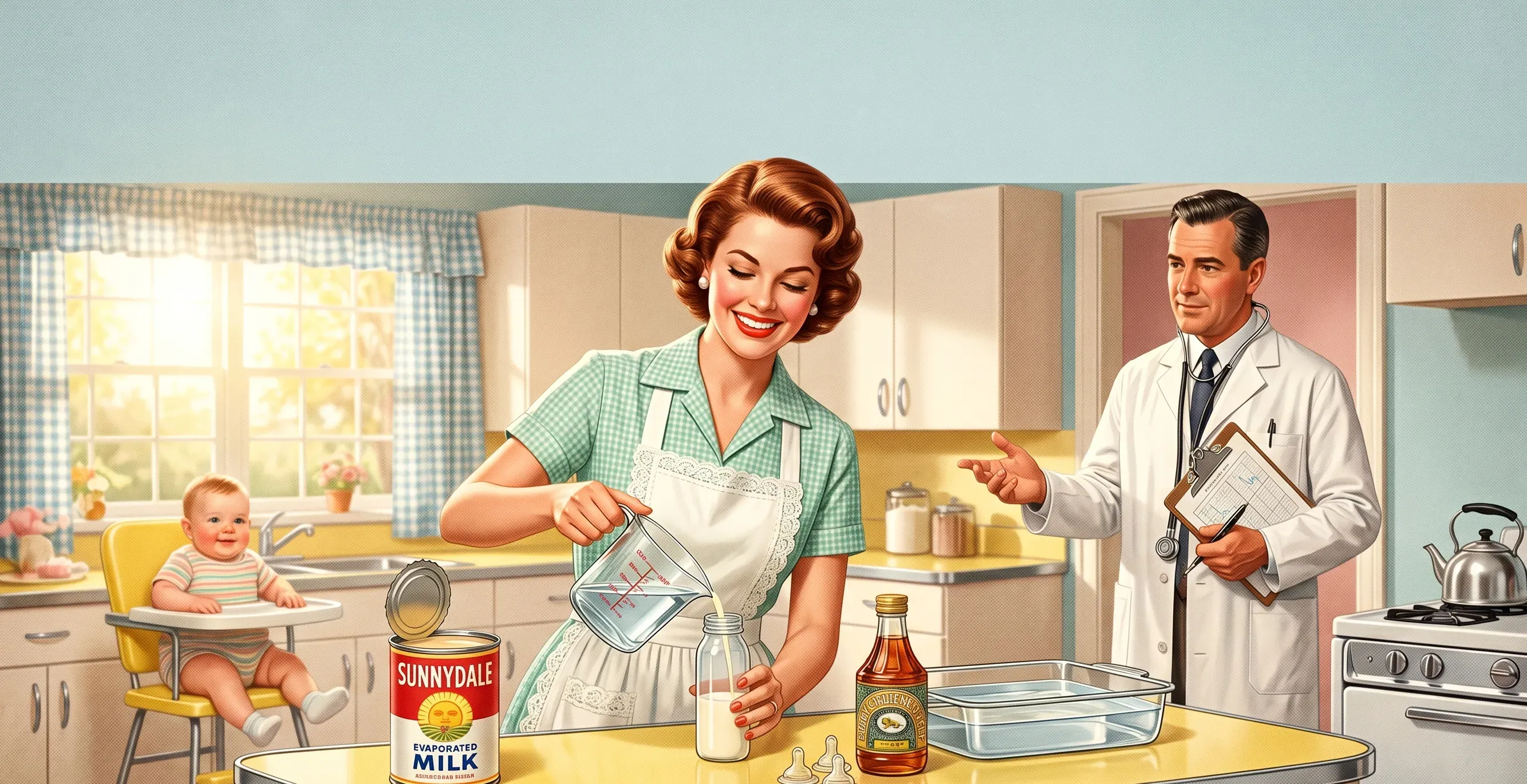
By the 1950s, breastfeeding had come to be perceived as old-fashioned, associated with lower-class women, and even described as “a little disgusting” among the affluent. A view enthusiastically endorsed by the medical establishment.[5] What replaced it? A cocktail of evaporated milk, boiled water, and corn syrup. Affordable, yes. Optimal, not quite. But it came with the blessing of science, and that was enough.
Gerber knew what it was doing
It was not just formula companies cashing in. The push to introduce solids earlier and earlier turned infant nutrition into a growth market, literally.
In 1880, the recommended age for solid foods was around eleven months. By 1950 it had plummeted to just six weeks.[6] Some paediatricians went further still. Florida paediatrician Dr Walter Sackett recommended cereal at birth, vegetable purees on day ten, meat at four weeks and black coffee by six weeks, to “help babies conform to daily life.”[7]
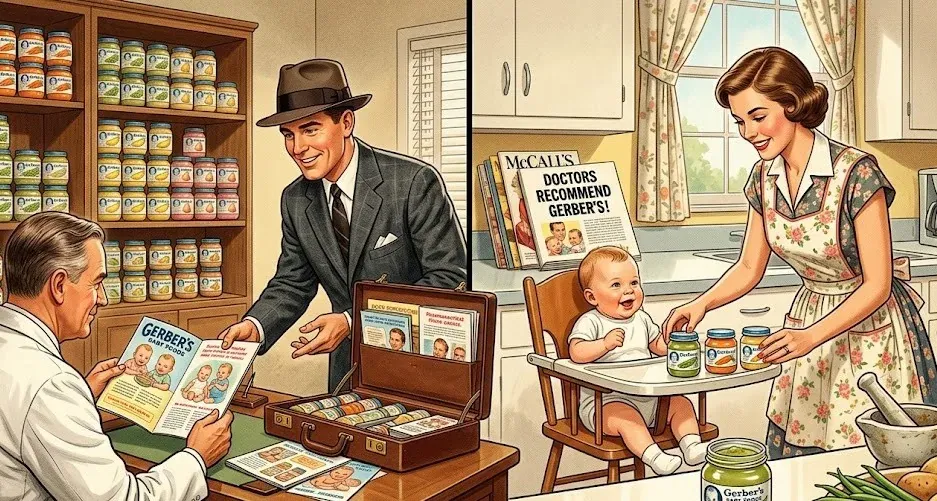
Gerber’s advertising campaigns targeted doctors directly, offering free products to any physician who requested them, and ran messaging convincing mothers that homemade baby food was neither as safe nor as good as the canned alternative.[6] Baby food sales tripled between 1949 and 1951.[8] Convenient, absolutely. But convenience rarely arrives without an agenda.
Scheduled hunger and the guilt industrial complex
While the food companies sorted the what, the medical establishment sorted the when.
Rigid four-hour feeding schedules were prescribed as the scientific standard. If your baby cried before the window opened, you were told to wait. For their own good, naturally.
This framework had a neat side effect. It made breastfeeding structurally almost impossible. When babies suck less frequently, milk supply drops. And so mothers began reporting they did not have enough milk. Doctors diagnosed “lactation failure.” Nobody connected it to the schedules they had prescribed.[9]
The hospital as the final frontier
That detail matters.
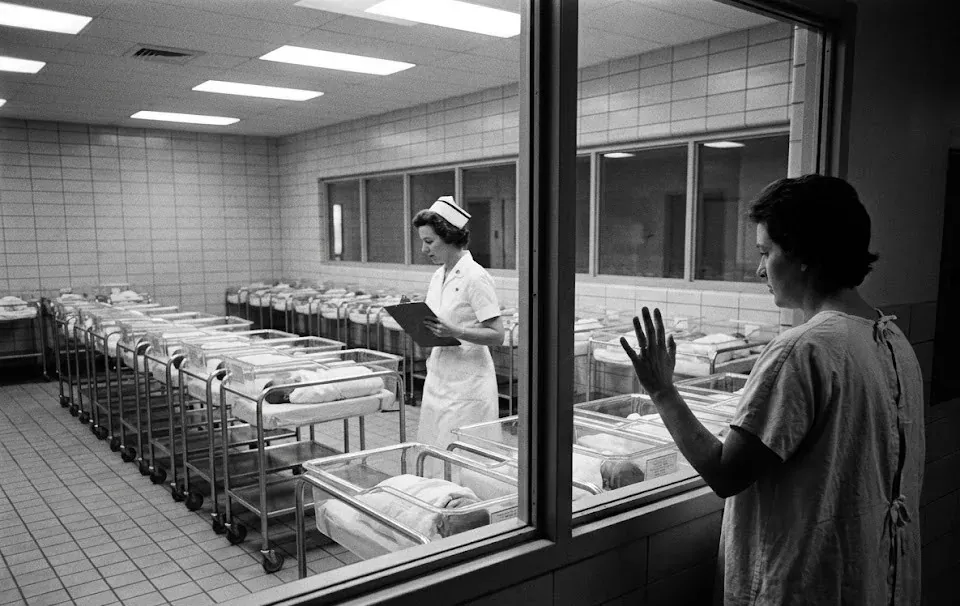
From the 1930s onward, maternity wards routinely separated newborns from their mothers, keeping infants in centralised nurseries and reuniting them only for brief, scheduled visits.[4] Skin-to-skin contact, rooting, the biological choreography of early feeding, all of it disrupted. All of it replaced by institutional efficiency. Mothers also frequently received lactation suppressants without their knowledge or consent.[10]
Meanwhile, at home, entire rituals of sterilisation emerged. Boiling glass bottles in large pots. Scrubbing rubber nipples. Purifying every surface that touched the feed. It was a lot of work. It looked like diligence. It was also a very effective way of making formula feel like the serious, responsible choice, and breastfeeding feel like the risky, unsanitary alternative.
The guilt was never yours to carry
The formula was not just in the tin. It was in the whole system telling women what modern motherhood looked like, and making sure the alternative felt impossible to pull off alone.
If feeding your baby has been hard, that is not a verdict on you. It is a verdict on a century that took away the village, the knowledge, and the time, and then sold you the replacement.
You are not failing at something natural. You are attempting something structurally difficult, in a culture that dismantled the scaffolding, and calling the resulting struggle “your fault” is the oldest trick in the book.
Frequently asked questions
Why is breastfeeding so hard when it is supposed to be natural?
Because a century of medicalisation, marketing, and rigid feeding schedules dismantled the practical scaffolding that made it work. Natural does not mean easy without support. In every culture that still supports mothers well, feeding is taught, watched, and held by other women. In the West that infrastructure was replaced by hospital nurseries, four-hour feeding windows, and a formula industry that benefited when mothers doubted themselves.
Why did formula feeding become the norm in the West?
By the mid-1950s around 80 per cent of American mothers were bottle-feeding. Not because it was better. The medical establishment declared formula the modern choice on very little evidence, and industry, hospitals, and advertising did the rest. Breastfeeding was reframed as old-fashioned. Formula was framed as scientific. The shift was engineered, not organic.
Was Dana Raphael for or against formula?
She was against the guilt. Raphael coined the term matrescence and campaigned for the support that lets mothers actually feed their babies, however they feed them. Her point was never that formula is wrong. It is that mothers were being blamed for the failure of a system that had removed the community, the knowledge, and the time they needed.
Why did doctors used to recommend solids at six weeks?
Because the growth of the baby food industry rewarded early introduction. In 1880 solids were recommended at around eleven months. By 1950 the figure had collapsed to six weeks. Some paediatricians pushed further still. The market moved the medical advice, not the other way round.
Is the guilt around breastfeeding my fault?
No. The guilt was cultivated. It has been cultivated for decades by industries and institutions that benefit when mothers doubt themselves. Struggling to feed is not evidence of failure. It is evidence of a system that never built the container mothers needed.
Sources and further reading
- 01 (n.d.). Dana Raphael. Link
- 02 (n.d.). Matrescence. How Dana Raphael defined the transition to motherhood. Link
- 03 (n.d.). Breastfeeding in America. Link
- 04 (n.d.). A brief history of baby feeding. Link
- 05 (n.d.). History and culture of breastfeeding. Link
- 06 (n.d.). The history of baby food. Link
- 07 (n.d.). Solids. A historical timeline. Link
- 08 (n.d.). Baby food for baby boomers. Link
- 09 (n.d.). Breastfeeding in the US. A complicated history of infant feeding. Link
- 10 (n.d.). From living rooms to hospitals. The breastfeeding movement and the limits of success. Link
Keep reading

The way Western culture treats new mothers is not normal
The overwhelm, the guilt, the pull between baby and career are not just how motherhood is. Why the way Western culture treats new mothers is not normal.

Depleted mother syndrome and mum burnout: signs, causes and recovery
Depleted mother syndrome is not a diagnosis, but the exhaustion is real. The signs, how it differs from postnatal depression, and what actually helps.