

Article
Depleted mother syndrome and mum burnout: signs, causes and recovery
It is half past ten in the morning. Everyone has been fed. Everyone has been washed. The baby is down, at least for now.
You sit on the edge of the sofa and there is nothing left. Not tired in the old way. Empty. You do not even have the energy to scroll.
Later, when you do pick up your phone, a phrase is waiting on your feed. Depleted mother syndrome. It sounds exactly like you.
Here is what I want you to know first. This is not a personal failing. It is what matrescence, the normal developmental passage into motherhood, can look like when you give far more than you get back, for far too long.
This post covers what the term is and is not, the signs worth noticing, how it differs from postnatal depression, why it happens and what actually refills the tank.
Is depleted mother syndrome real?
The feeling is real. The label is informal.
The phrase comes from a book. Rick Hanson, Jan Hanson and Ricki Pollycove introduced it in Mother Nurture, a guide to mothers’ health published by Penguin in 2002. In Rick Hanson’s own words, the authors “proposed that there can be an actual Depleted Mother Syndrome”.[1]
Proposed is the honest word. It was an idea offered to mothers in a self-help book, not a condition defined through research. More than two decades later, the phrase is popular on social media. Even health sites that use it are careful to say it is not a recognised medical diagnosis.[2]
There is a research side, though. Researchers have been studying the same experience, the one many people call mum burnout (or mom burnout in the US), under another name: parental burnout. In 2021, the researchers Mikolajczak, Gross and Roskam described it as “an exhaustion syndrome related to the parenting role”. They link it to a gap between what parenting demands of you and the resources you feel you have. They also noted that it had long been taboo.[4]
Why not simply call it burnout? Because the World Health Organization keeps that word for work. It describes burn-out as an occupational phenomenon that “should not be applied to describe experiences in other areas of life”.[3] Parental burnout is studied as its own thing, with its own signs, rather than borrowed from the office.
So the label is informal. The experience is real, and it has been studied. You are not imagining it.
Signs worth noticing
Depletion rarely announces itself. It creeps in, one short night and one extra job at a time.
A study of more than 17,000 parents in 42 countries measured parental burnout through four core signs.[6]
The first is exhaustion in your role as a mother: feeling completely run down by mothering itself, well beyond a bad night. The second is a contrast with your old self: the sense that you are no longer the mother you used to be. The third is losing the pleasure. The parts of mothering that once felt good start to feel like jobs. The fourth is emotional distance from your children. You do what needs doing, but from further away.
If the loss of pleasure is the part that frightens you, read is it normal not to enjoy motherhood? Love and enjoyment are not the same thing.
If a short fuse is what you notice most, read about postpartum rage, which looks at the part sleep and an unshared load can play.
None of this makes you a bad mum. Every wave of fatigue or feeling of overwhelm is information, not weakness. These are prompts for a conversation, not a verdict. Nobody needs you to score yourself.
Depleted, burnt out or postnatal depression?
This part matters most. Parental burnout and postnatal depression are related, but they are not the same thing.
When researchers developed a measure of parental burnout, its scores overlapped with depression only partly. Their conclusion was that parental burnout is not just burnout, stress or depression.[5] But the two can travel together. In one study of postnatal mothers, more depressive symptoms went with more parental burnout.[8]
That overlap is why feeling depleted is a reason to check in, not a reason to rule depression out. Postnatal depression can start at any point up to a year after birth. Health guidance says it is worth getting help even if you only have some of the signs.[9] US guidance adds that being very tired may be a major contributor to postpartum depression.[10]
Tiredness can have physical causes too. Looking after a new baby is a common reason to feel exhausted. But if you have been tired for a few weeks and you are not sure why, see a doctor rather than trying to diagnose yourself.[11]
So please do not sit alone deciding which one you have.
A doctor can talk you through the options. Telling the two apart is their job.
Why it happens
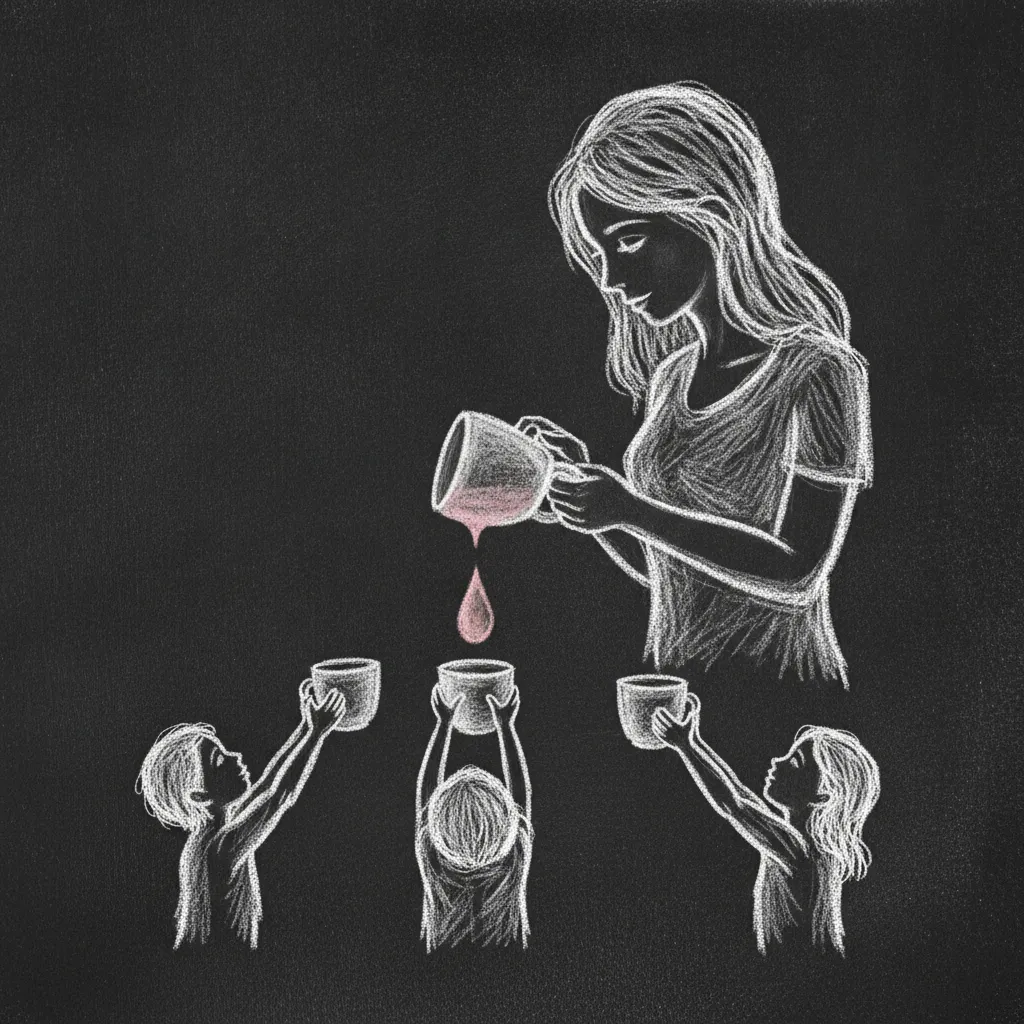
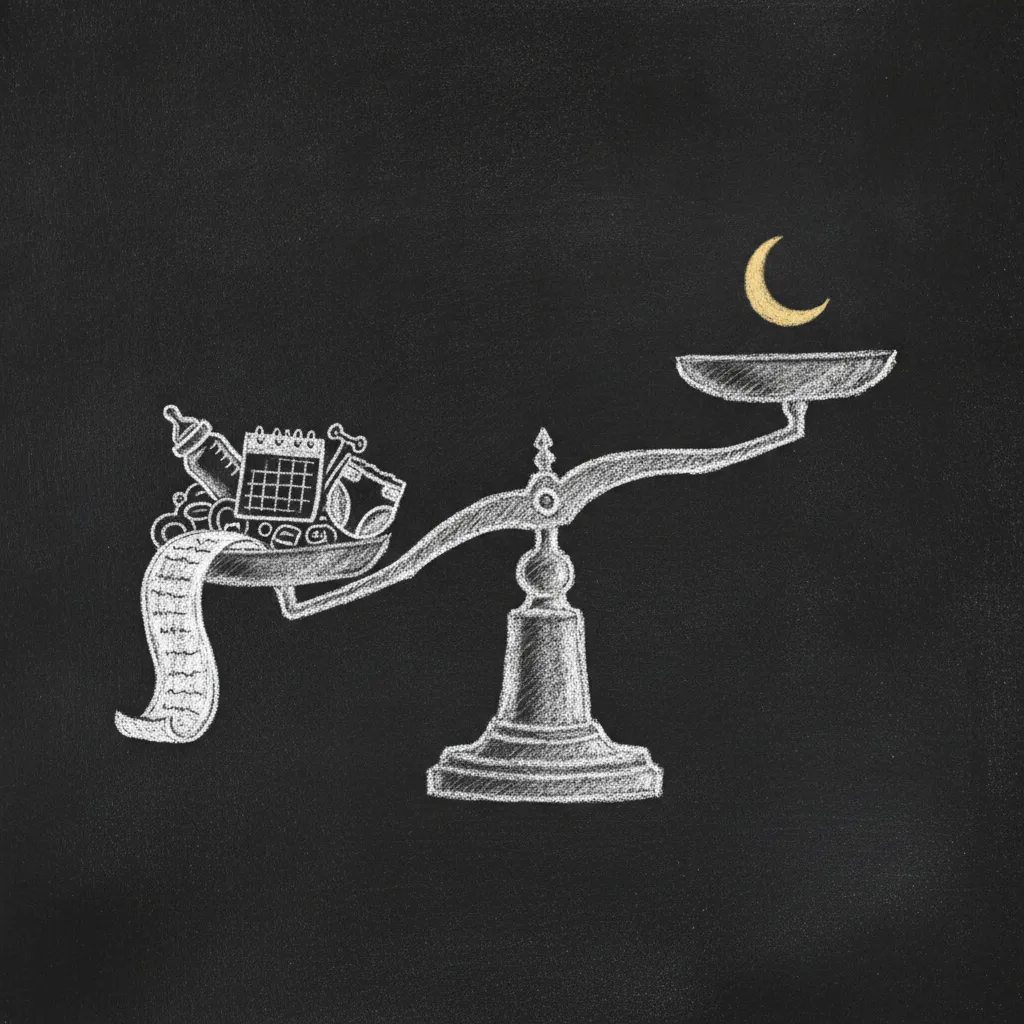
Think about the shape of your days. Feeds, washing, meals, appointments, the running list in your head. The demands keep arriving. The resources, meaning sleep, help and time that is yours, do not.
Researchers describe the same imbalance. Parental burnout grows from a gap between what parenting asks of you and what you have to give.[4]
Culture widens the gap. In the 42-country study, burnout was noticeably more common in individualistic countries, the cultures that prize independence.[6] Rates varied widely between the study’s samples: 3.0% of parents in the UK sample and 7.9% in the US sample, for example. The samples also included parents in Burundi, Cameroon, Rwanda and Togo. So this is not only a Western story, even if most of the research is Western.
My own reading, and it is an interpretation rather than a finding: city life, a nuclear family and a demanding career can carry the same pressures wherever you live. For what Western culture took away from new mothers, read how Western culture treats new mothers.
Later work by the same team asked why individualism matters. The biggest reason was the gap between the parent people feel they are supposed to be and the parent they actually are. Low sharing of parenting tasks played a part too.[7] If that first gap sounds familiar, it sits very close to what drives mum guilt.
Then there is the work nobody sees. A review of the research found that women carry the larger share of the mental labour of childcare and parenting decisions. They also carry more of its costs, including stress and lower satisfaction with life and relationships.[12] The mental load is not only doing the tasks. It is remembering them, planning them and noticing when they are due.
Asking for help does not come easily either. In the Phoenix Report, my small survey of mothers, most of them in Switzerland, 55% of those who completed it said they do not instinctively ask for help when they need it. They default to managing alone.
So if you are overwhelmed, it does not mean you are weak or bad at motherhood. It means you are doing work that humans were never meant to do alone.
How long does it last?
Nobody can give you a reliable answer. Depleted mother syndrome is not a research diagnosis, so it has no measured timeline. The parental burnout studies behind this post do not give one for the early years either.
The cause, though, points somewhere useful. If depletion comes from a gap between demands and resources, waiting is unlikely to close it on its own. Changing the balance matters more than counting the weeks.
Postnatal depression is better mapped. It usually gets better in three to six months, but it can sometimes last much longer.[9] Use that as a guide for when to ask, not as a deadline. If the heaviness is not lifting after a few weeks, speak to your doctor or midwife.
What actually helps
I remember feeling so low on energy after having my babies. Not just for days. Months.
“Sleep when the baby sleeps.” I tried. But after having my children, I reached a point where I was so sleep-deprived my whole body ached. And somehow I was still doing the laundry, the dinners, tidying the house, and carrying the mental load. Coffee was not helping.
I did not need to become better at coping. I needed help. So I talked to my husband. We redistributed the workload. He took more night shifts, and I finally had stretches of uninterrupted sleep.
That is the whole model in one story. Fewer demands. More resources. No single step works for everyone, but these three follow from the cause.
Take something off your plate
Start with the load, because it is the part most likely to be invisible. For one week, write down everything you hold in your head: the nappy order, the vaccinations, the birthday presents, what runs out next. Making the invisible visible comes first. Nobody can share work they cannot see.
Then hand over whole jobs, not tasks. Instead of “can you pick up nappies?”, try “nappies are yours now: noticing, ordering, restocking.”
Nights are the obvious place to begin. If you have a partner, make the ask concrete. “Tonight, you take everything that does not need feeding. Settling, nappies, resettling, and bringing me the baby.”
Put something back
Resources matter as much as demands. Protect stretches of unbroken sleep where you can, not just more hours in bed.
Then add people. Your village does not have to look historical. It might be your partner taking real ownership. A grandmother on FaceTime. A babysitter. A friend swapping childcare. A playgroup. A neighbour.
And keep one thing that is yours. Not self-care as another task to fail at. Something small that reminds you there is a person inside the role. If you are heading back to work, build this in before you return. My guide to going back to work after a baby covers the conversations to have first.
Lower the bar you did not set
Remember the gap from earlier: the distance between the mother you are and the mother you think you should be.[7] You did not write that standard. Notice when you are measuring yourself against it, and ask whose rule it is. If the measuring is done by a harsh inner voice, turning your inner critic into an inner coach is a good place to start.
So go back to that moment on the sofa. Everyone fed, washed and settled. You, empty.
The question for tonight is not how to cope better. It is this: what is one job someone else can own from tomorrow? Not help with. Own.
Name it. Hand it over.
You do not have to reach breaking point to deserve rest.
Frequently asked questions
Is depleted mother syndrome a real diagnosis?
No. It is an informal name introduced in Mother Nurture, a 2002 self-help book, and it is not a recognised medical diagnosis. The experience it describes is real. Researchers study it as parental burnout: an exhaustion syndrome tied to the parenting role, linked to a gap between what parenting demands and the resources you have.
How long does depleted mother syndrome last?
Nobody can say. It is not a research diagnosis, so it has no measured timeline. Because it comes from more demands than resources, changing that balance matters more than waiting. If it is not lifting after a few weeks, speak to your doctor or midwife.
What are the signs of mum burnout?
Research on parental burnout describes four core signs: feeling run down by your role as a mother, feeling you are no longer the mother you used to be, losing the pleasure in mothering, and emotional distance from your children. Treat them as prompts for a conversation with your doctor or midwife, not a test.
Is depleted mother syndrome the same as postnatal depression?
No, but they are related, and they can travel together. Postnatal depression can start any time up to a year after birth, and it is worth getting help even with only some of the signs. You do not have to decide which one you have. Your doctor or midwife can help.
Can fathers get parental burnout?
Yes. The 42-country study of parental burnout included fathers as well as mothers, and parental burnout is studied in all parents. This article speaks to mothers in the first years after birth.
If you are struggling
This article is for information, not medical advice. Mags Salton is a mentor and coach, not a clinician. If you have felt low most days for more than two weeks, have thoughts of harming yourself or your baby, or feel you cannot cope, please speak to your doctor or midwife. If anyone is in immediate danger, contact your local emergency services.
Sources and further reading
- 01 (2002). Mother Nurture: A Mother's Guide to Health in Body, Mind, and Intimate Relationships. Penguin Books (Open Library record OL12282134W). The authors' own wording on the term is quoted from Hanson, R. (2017), 10 reasons to take good care of a mother, an article adapted from the book (linked). A self-help book; the term is the authors' proposal, not a research finding. Link
- 02 (n.d.). Mom burnout: are you dealing with depleted mother syndrome?. Cleveland Clinic Health Essentials. Accessed 19 October 2026. Link
- 03 (2019). Burn-out an "occupational phenomenon": International Classification of Diseases. WHO. ICD-11 includes burn-out as an occupational phenomenon, not a medical condition. Link
- 04 (2021). Beyond job burnout: parental burnout!. Trends in Cognitive Sciences, 25(5), 333-336. Link
- 05 (2017). Exhausted parents: development and preliminary validation of the Parental Burnout Inventory. Frontiers in Psychology, 8, 163. Two online community samples (379 and 1,723 parents). Burnout showed low to moderate correlations with depression. Link
- 06 (2021). Parental burnout around the globe: a 42-country study. Affective Science, 2(1), 58-79. 17,409 parents, 71% of them mothers, with children of any age. Mostly convenience and snowball samples, not representative of each country, so country figures describe the study's samples only. No sample from India. Link
- 07 (2024). Three reasons why parental burnout is more prevalent in individualistic countries: a mediation study in 36 countries. Social Psychiatry and Psychiatric Epidemiology, 59(4), 681-694. 16,059 parents. The largest mediator was the gap between socially prescribed and actual parental selves; low task sharing also mattered. Link
- 08 (2023). Exploring the relationship between postnatal depressive symptoms and parental burnout from the perspective of the population and individual level. BMC Psychiatry, 23, 409. 560 postnatal mothers, a cross-sectional convenience sample; authors based in China. An association, not proof of cause. Link
- 09 (2026). Postnatal depression. UK guidance on signs, timing and recovery. Page last reviewed 18 March 2026. Link
- 10 (2025). Postpartum depression (patient FAQ). ACOG. US guidance. Last reviewed December 2025. Link
- 11 (2023). Tiredness and fatigue. UK guidance on common causes and when to see a doctor. Page last reviewed 2 June 2023. Link
- 12 (2023). Gendered mental labor: a systematic literature review on the cognitive dimension of unpaid work within the household and childcare. Sex Roles, 88, 475-494. A review of 31 articles, mostly from US and European middle-class samples. Link
Keep reading

Postpartum rage: why it happens and how long it lasts
Sudden, intense anger after a baby is not a character flaw. Why postpartum rage happens, how long it lasts and when to speak to your doctor or midwife.

Understanding what happens with your hormones after birth
What your hormones do after birth: the brain changes, the mood swings that have a name, the identity shift that has a reason. Explained properly, finally.