
Article
Understanding what happens with your hormones after birth
I remember it like it was yesterday.
We were telling our friends Rob and Olga, seasoned parents of a five-year-old, that we were pregnant. We were ecstatic. Absolutely basking in our own glory. And their response?
“Oh boy. Are you in for a shock.”
You can tell when you have great friends. They tell you the truth.
We, of course, brushed the truth off with a breezy “how hard can it be?” and continued basking.
And then we brought our perfect firstborn home.
And oh boy, were we in for a shock.
It was not even the baby stuff that I was struggling with most. Although yes, obviously, also that. It was the seismic shifts I was experiencing in me that I had absolutely no context for. Changes I had not been warned about, had not prepared for, could not name or explain. Which made the whole experience, and I am being generous here, quite overwhelming. There were days I was sprawled on the floor next to my newborn, the two of us wailing away together in a kind of collective meltdown.
I was mortified. What was happening to me?
Here is the thing. I had been so completely terrified of the giving birth part. Hypnobirthing. Birth plans. Hospital bags researched to within an inch of their lives. That I had not actually learnt a single thing about what to expect after birth. Specifically, the extraordinary, chaotic, scientifically fascinating changes that would be happening in my body, brain, hormones, and identity. Nobody mentioned any of it.
So I am going to mention it. All of it. In language a real human can understand. With the science behind it, because knowing why something is happening changes everything about how you live through it. The hormones are one part of a bigger transformation called matrescence.
Consider this the briefing you deserved before you went into labour.
The placenta leaving is a bigger deal than anyone told you
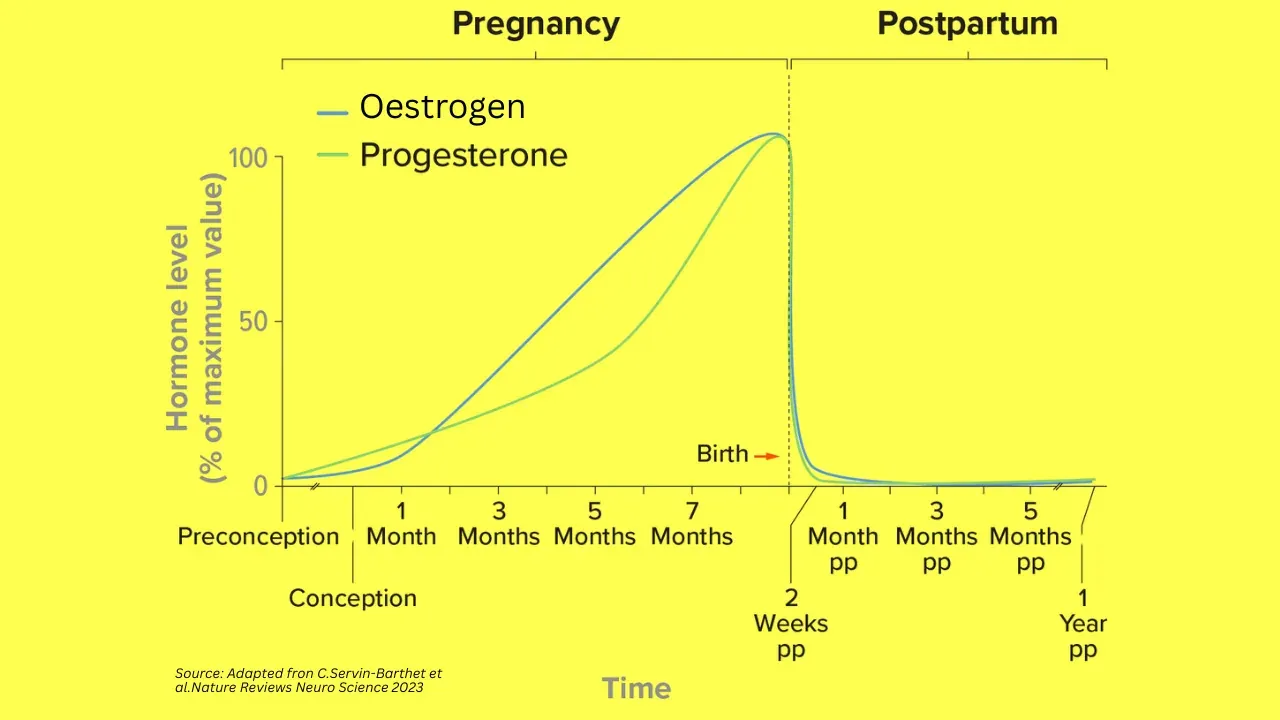
For nine months, your placenta has been running a pharmaceutical operation of truly spectacular scale. It has been producing enormous quantities of oestrogen and progesterone, at levels higher than at any other point in a woman’s life, and those hormones have been doing a staggering amount of work. Maintaining the pregnancy. Supporting the growing brain of your baby. Keeping your mood relatively stable. Managing your immune system. Essentially, holding the whole show together.
And then the placenta comes out.
And the pharmaceutical operation shuts down.
Overnight.
Imagine oestrogen and progesterone as the scaffolding that has been holding the entire structure of your mood, energy, and emotional regulation together for the last nine months. The placenta leaving is the moment that scaffolding is pulled down all at once.
You are then expected to immediately care for a newborn. While the scaffolding is still on the floor.
Meet the cast
Postpartum is not a one-hormone story. It is an entire ensemble production. Every member of the cast is doing something different to your body, brain, mood, and sense of self simultaneously. Let us meet them properly.
Oestrogen. The mood architect.
During pregnancy, sky-high. After birth, crashes by up to 90 per cent within 48 hours. Oestrogen is critical for serotonin and dopamine production, the neurotransmitters that regulate mood, motivation, and pleasure. When it drops, those systems go wobbly with it. This is why you might feel perfectly fine one moment and utterly bereft the next, for no apparent reason. It is not a character flaw. It is chemistry.
Progesterone. The calm-down chemical.
Think of progesterone as your body’s built-in sedative. During pregnancy it produced a natural neurosteroid called allopregnanolone, essentially your brain’s own valium, which kept anxiety in check and promoted calm. Post-birth, that drops along with everything else. Cue the anxiety, the racing thoughts, the 3am spirals, the sense that something terrible is about to happen even when nothing is. That is the allopregnanolone leaving the building.
Oxytocin. The bonding hormone.
Here is the good news in this story. Oxytocin surges during birth, during skin-to-skin contact, and with every breastfeed. It is extraordinary. It drives the overwhelming, almost animal love you feel for your baby. It helps your uterus contract and reduces bleeding. It is your body actively building the mother-baby bond in real time. The catch. Oxytocin is also intensely sensitising. It makes your threat-detection sharper. Which is why you will simultaneously feel floods of love and the visceral certainty that you must protect this baby from literally everything. Including, occasionally, the people you love most.
Prolactin. The milk maker.
Prolactin rockets in the days after birth to trigger milk production and stays high for as long as you breastfeed. It has a calming, even sedative quality of its own, which helps with the relentlessness of newborn care. The less-discussed side. Prolactin suppresses oestrogen, which keeps libido low and keeps periods away while you are nursing. This is evolutionary logic, spacing out pregnancies and conserving resources. But it also means some of the emotional flatness you may feel while breastfeeding is hormonally constructed, not a reflection of how you actually feel about your life.
Cortisol. The survival chemical.
Cortisol, your primary stress hormone, stays elevated in the postpartum period, and for good biological reason. It keeps you alert, vigilant, and capable of caring for a newborn on almost no sleep. It is technically helping you survive. The problem. Chronically elevated cortisol erodes mood, disrupts sleep even when you are desperately trying to sleep, affects memory, and amplifies anxiety. You are being kept biologically awake and on high alert. On purpose. By your own hormones. Because evolution does not care that you are exhausted.
Thyroid hormones. The wildcard.
Up to 10 per cent of postpartum women experience postpartum thyroiditis. This is an inflammatory shift in thyroid function that can first cause hyperthyroid symptoms (heart palpitations, anxiety, irritability, unexpected weight loss) and then swing into hypothyroidism (profound fatigue, low mood, weight gain, brain fog). It frequently goes undiagnosed because the symptoms are easily attributed to just being a new mother. If something feels persistently, specifically wrong (especially after the first few months) ask your doctor to check your thyroid. It is a simple blood test.
And then there is the brain
Giving birth does not just change your hormones. It physically changes the structure of your brain.
This is not a metaphor. This is neuroscience.
A landmark 2017 study in Nature Neuroscience by Hoekzema and colleagues was the first to conclusively demonstrate that pregnancy causes significant, measurable, long-lasting changes to grey matter in the maternal brain, specifically in the regions governing social cognition, empathy, attunement, and threat detection.[1] A 2024 precision imaging study by Pritschet et al. mapped these changes across an entire pregnancy in unprecedented detail, confirming that few regions of the brain are left untouched by the transition to motherhood.[2]
The grey matter reduction that happens postpartum looks alarming until you understand what it actually is. It is not loss. It is targeted pruning. The same process that happens in adolescence, where the brain removes unused neural connections to make the remaining ones faster and more efficient.
For the full picture on what mum brain is, what the phenomenology feels like, and why it is not a sign of decline, read Mum brain: is it real, how long does it last, and what actually happens. This post is about the hormones. The other one is about the brain that they are working on.
What this does to your mood
This is the part that really blindsided me. Not the crying. I expected some crying. Not the exhaustion. I had been warned. It was the way everything I cared about seemed to rearrange itself without my permission.
Things I had cared about deeply. Career status. Social reputation. How I looked. What people thought of my opinions. All suddenly sat differently in me. Some of them felt genuinely less important. Others felt more urgent than they ever had. My priorities were being silently rewritten and I had not signed off on any of it.
This, it turns out, is not a crisis. It is also science.
The same neurological restructuring that builds the mother-baby bond also shifts what the brain registers as important. The regions most actively remodelled postpartum (the medial prefrontal cortex, the anterior cingulate cortex, the amygdala) are the regions governing not just empathy but threat evaluation, risk assessment, and what we care about most. When those regions are being rebuilt around a new primary attachment, values reorganise around them.[6]
You did not choose to care differently. Your brain was remodelled to care differently. The things that feel newly urgent are newly urgent for a reason. The things that feel less important may genuinely be less important now. That is not a betrayal of your former self. It is the former self being integrated into something larger.
And the emotional swings. The weeping at an advert. The rage at a small inconvenience. The love so intense it feels like a physical pain. The bleak flatness that can arrive without warning. All of that is the hormonal and neurological orchestra playing at full volume, all the instruments at once, while the conductor is operating on four hours of broken sleep.
You are not unstable. You are navigating the most significant physiological event of your adult life, with almost no preparation and far too little support.
When does it settle? An honest timeline.
I know you want a date. I wish I could give you one. Here is the most honest version of what the research shows.
If I had known any of this. If someone had sat me down before I left the hospital and said, here is what is about to happen to your hormones, and here is what it will feel like, and here is why, and here is roughly how long it lasts, then I would not have spent those early weeks sprawled on the floor wondering if I was fundamentally broken.
I was not broken. I was doing the most physiologically complex thing my body had ever done, with no map and no briefing.
You are not broken either.


Frequently asked questions
Why do I cry so much after giving birth?
Because oestrogen and progesterone, which have been at record highs for nine months, drop by up to 90 per cent within 48 hours of delivering the placenta. These hormones are central to serotonin and dopamine production, the neurotransmitters that regulate mood, motivation, and emotional stability. When they plummet that fast, the brain's mood regulation systems go into a kind of withdrawal. The tearfulness of the early postpartum days is called the baby blues. It affects up to 80 per cent of new mothers, typically peaks around days 3 to 4, and generally eases by the end of week 2. If the low mood persists beyond two weeks or is deepening, speak to your doctor or midwife. That could be postpartum depression, which affects 1 in 7 mothers and is entirely treatable.
How long do postpartum hormone changes last?
The most dramatic hormonal changes happen in the first 48 to 72 hours. Most hormones approach pre-pregnancy levels by around six months postpartum, though this is later for women who are exclusively breastfeeding, since prolactin remains elevated throughout nursing. The baby blues typically resolve within two weeks. Postpartum depression and anxiety, if they develop, can persist longer and require treatment. Thyroid issues can emerge between 1 and 6 months and often go undiagnosed. And the structural brain changes of the postpartum period persist for at least two years. These are adaptations, not damage.
What is the difference between baby blues and postpartum depression?
Baby blues are a normal hormonal response affecting up to 80 per cent of new mothers. Tearfulness, mood swings, anxiety, and emotional instability in the first 1 to 2 weeks after birth, caused by the dramatic drop in oestrogen and progesterone. They resolve on their own as hormones begin to stabilise. Postpartum depression is a clinical condition affecting around 1 in 7 new mothers. It typically begins 2 to 8 weeks postpartum, though it can emerge anytime in the first year. It involves persistent low mood, inability to feel pleasure, intrusive thoughts, and difficulty bonding. PPD does not resolve on its own. It requires support and often treatment. It is the number one complication of childbirth.
Why am I so anxious after having a baby?
Several things are happening simultaneously. Progesterone, which produced a natural neurosteroid called allopregnanolone with profound calming effects during pregnancy, has dropped sharply after birth. Oestrogen, which supports serotonin production, has also crashed. Cortisol is deliberately elevated to keep you alert and responsive to your newborn's needs. And oxytocin, while driving love and bonding, sharpens threat detection. You are neurochemically primed for vigilance right now. This is evolutionarily purposeful and personally exhausting. If the anxiety feels unmanageable or is interfering with your ability to function, please speak to your doctor. Postpartum anxiety is as common as postpartum depression and is very treatable.
Why does my libido disappear after having a baby?
Multiple hormones are conspiring here, and none of it is personal. Prolactin, elevated throughout breastfeeding, suppresses oestrogen, which in turn suppresses libido. The oestrogen drop also causes vaginal dryness and tissue sensitivity that can make sex uncomfortable. Elevated cortisol dampens desire further. And oxytocin directs attachment energy primarily toward the infant. It typically improves as hormones stabilise, sooner for non-breastfeeding mothers, later for those still nursing. If it persists beyond the hormonal adjustment period, it is worth raising with your doctor.
Should I get my thyroid checked after having a baby?
If something feels persistently, specifically wrong, especially after the first few months, yes. Up to 10 per cent of postpartum women experience postpartum thyroiditis, an inflammatory shift in thyroid function that can first cause hyperthyroid symptoms (heart palpitations, anxiety, unexpected weight loss) and then swing into hypothyroidism (profound fatigue, low mood, weight gain, brain fog). It frequently goes undiagnosed because the symptoms are easily attributed to just being a new mother. It is a simple blood test. Ask.
Sources and further reading
- 01 (2017). Pregnancy leads to long-lasting changes in human brain structure. Nature Neuroscience, 20(2), 287-296. Link
- 02 (2024). Neuroanatomical changes observed over the course of a human pregnancy. Nature Neuroscience, 27, 2253-2260.
- 03 (2024). Women's neuroplasticity during gestation, childbirth and postpartum. Nature Neuroscience, 27, 319-327.
- 04 (2025). From pregnancy to postpartum. The dynamic reorganisation of the maternal brain. Neuroscience Insights.
- 05 (2023). Matrescence. Lifetime impact of motherhood on cognition and the brain. Trends in Cognitive Sciences, 27(3), 302-316.
- 06 (2024). Enduring maternal brain changes and their role in mediating motherhood's impact on well-being. Scientific Reports.
- 07 (2015). The role of reproductive hormones in postpartum depression. PMC.
Keep reading

Depleted mother syndrome and mum burnout: signs, causes and recovery
Depleted mother syndrome is not a diagnosis, but the exhaustion is real. The signs, how it differs from postnatal depression, and what actually helps.

Postpartum rage: why it happens and how long it lasts
Sudden, intense anger after a baby is not a character flaw. Why postpartum rage happens, how long it lasts and when to speak to your doctor or midwife.