

Article
Patrescence, and why it matters for your relationship after a baby
There is a word for what is happening to you. You probably already know it. There is also a word for what is happening to him. And if nobody has told you that word yet, it might explain quite a lot.
You are going through matrescence. The neurological, psychological, and identity transformation into motherhood. The science is clear and the evidence is substantial. You are not struggling because something has gone wrong. You are struggling because something extraordinarily demanding is happening, and the culture gave you no map for it.
But here is the part that often gets missed.
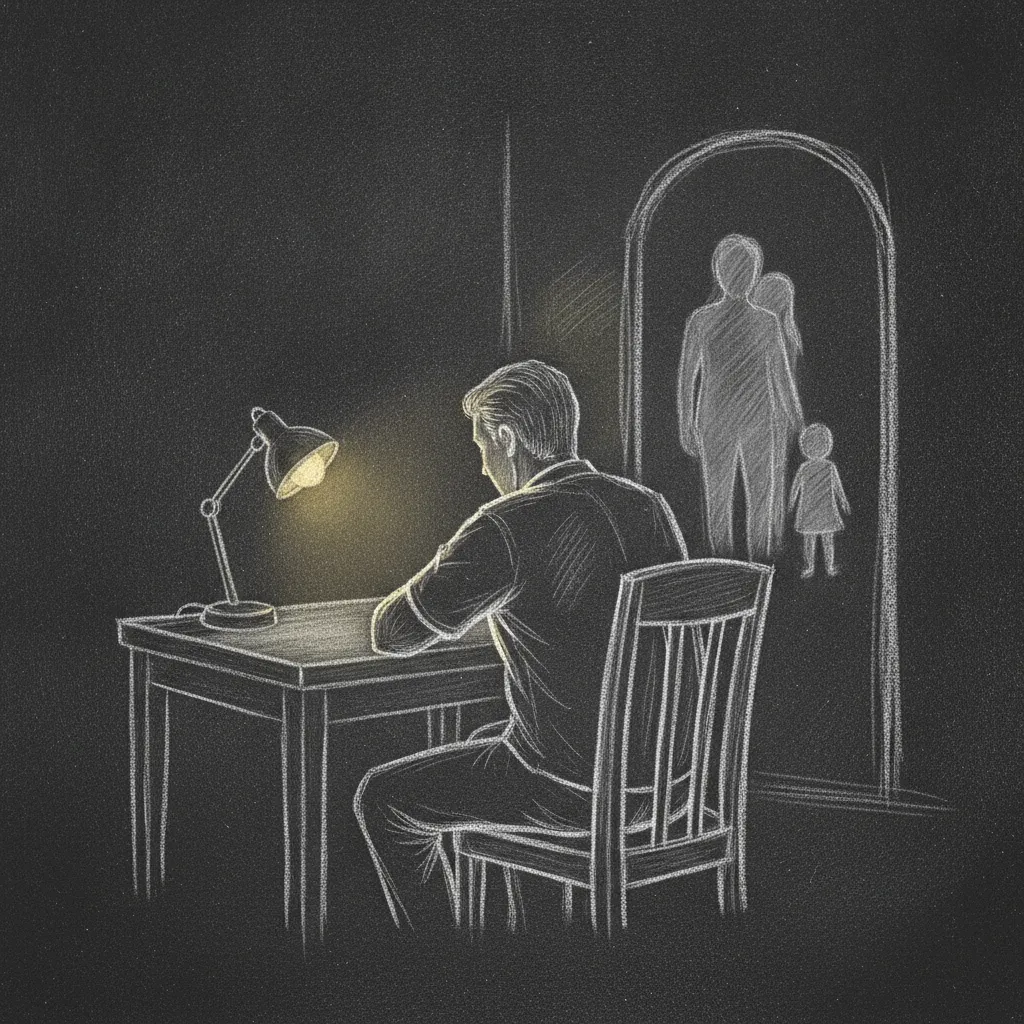
He is going through something too.
It is called patrescence. And understanding it may be one of the most useful things you do for your relationship right now.
What patrescence is
Patrescence describes the process of a man becoming a father in the same way that matrescence describes the process of a woman becoming a mother. Both terms were shaped by the same foundational insight. That becoming a parent is a developmental life stage with its own psychological weight, its own timeline, and its own need for recognition.
The difference between the two is the research base. Matrescence has the longer history. Dana Raphael coined it in 1973, Aurelie Athan revived and expanded it in 2008, and by 2017 Alexandra Sacks had introduced it to a mainstream audience in The New York Times.
Patrescence is newer to the conversation. The science of paternal brain changes is younger, but it is growing. What it is finding is not a mirror image of matrescence. It is something quite different. And understanding that difference is precisely what matters for your relationship.
What the research says about what is happening to him
Several things happen neurologically and psychologically to a man when he becomes a father. They are worth knowing.
Brain changes do occur in new fathers. A study published in Social Neuroscience (Kim et al., 2014) found structural brain changes in fathers during the early postpartum period, particularly in regions associated with motivation, reward, and social cognition.[1] The changes were less pronounced than those in mothers and appear more gradually, partly through sustained caregiving contact over time.
Caregiving involvement shapes the neurological response. Research published in Psychoneuroendocrinology (Feldman et al., 2010) found that fathers who were primary caregivers showed higher activation in the amygdala and in social-cognitive brain networks similar to patterns seen in mothers.[2] His brain responds to his involvement with the baby. The more hands-on he is, the more his neurology adapts.
Testosterone levels shift. Research published in PNAS (Gettler et al., 2011) found that fathers’ testosterone levels drop significantly in the first months of a baby’s life, more so in fathers who are actively involved in caregiving.[3] This is not a loss. It is a biological shift that supports nurturing behaviour. His body is adjusting to parenthood too.
Identity restructuring is also real and documented. Research on new fathers consistently shows disruption to self-concept, professional identity, and relationship identity in the first year. Men in the transition to fatherhood report feeling less certain about who they are, what they want, and where they stand in the relationship. The vocabulary for this is less developed than it is for mothers, which means many men are in the middle of this transition without a name for it.
Why this matters for you
You are not reading this because you are looking for ways to understand him better in an abstract sense. You are reading this, most likely, because something is fraying.
Maybe he seems distant when you most need him present. Maybe you are doing more than you expected, and he is doing less than you expected, and neither of you can quite explain why without it becoming an argument. Maybe you feel like you are both in the middle of something enormous and you are not in it together.
These are the most common relationship ruptures in early parenthood. They have a pattern, and the pattern is traceable.
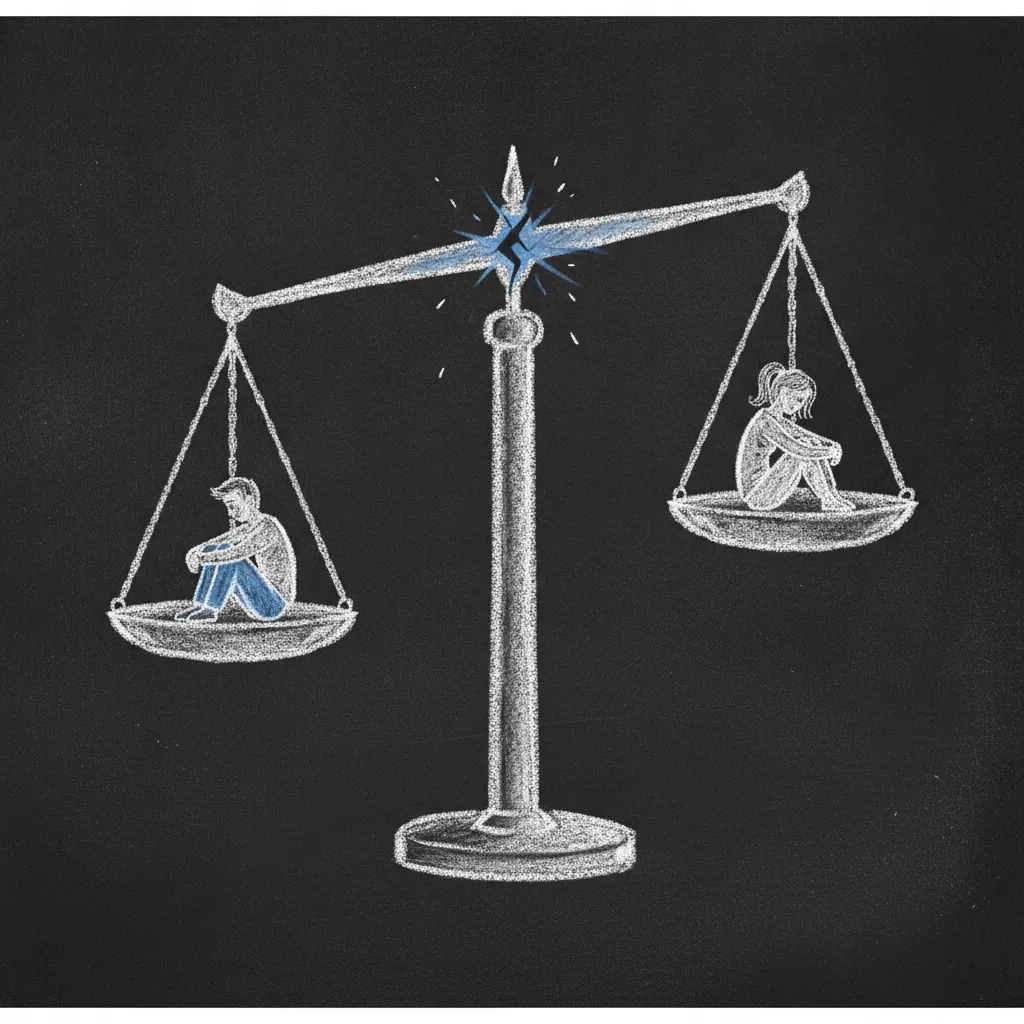
You are both going through a transition. But you are going through different versions of it, on different timelines, with different visibility, and different levels of cultural permission to name what is happening.
Your matrescence begins during pregnancy. The hormonal shifts, the neurological restructuring, the early identity disruption. These are already underway before your baby arrives, and they accelerate dramatically in the days and weeks after birth. His patrescence tends to unfold more slowly. The brain changes in fathers build over months of caregiving contact. His transition is less acute and less visible, which means it is also less attended to. By him. By you. By anyone around you.
This asymmetry is not a design flaw in your relationship. It is a biological and cultural reality. When it is invisible, it becomes the source of the disconnect.
The three ways patrescence shows up in the relationship
Understanding patrescence is useful not as a way of excusing unhelpful behaviour, but as a way of diagnosing what is actually happening. Here is where it most commonly surfaces.
The investment gap: when he struggles to bond with the baby
For mothers, the transition is immediate and biologically unavoidable. For fathers, the neurological and emotional investment builds through contact and caregiving over time. The fathers who show the strongest brain changes in studies are those who are most actively involved in their baby’s care.
If he is less present, less bonded, less emotionally invested in the early months, this may not be indifference. It may be a developmental process that requires input to develop. The fathers who lean in, who take the overnight shift, who do the feeds and the nappy changes and the soothing, are not just doing domestic labour. They are building the neurological infrastructure for their own parental investment.
This does not make the gap fair. But it makes it something you can name and address directly, rather than a character deficiency.
If your partner is struggling to bond with your newborn, time alone with the baby is often the most useful thing you can offer. Not supervised help. Full responsibility for a feed, a bath or a morning, so that he finds his own way of soothing instead of watching yours. Bonding for fathers is less a feeling that arrives and more a relationship that is built.
The identity retreat
The research on patrescence shows that many new fathers respond to identity disruption by doubling down on a domain where they feel competent and valued. Work.
If he is working longer hours, taking on more projects, travelling more, and framing all of this as providing for the family, you are likely looking at an identity retreat.
Before the baby, he had a clear self-concept. After the baby, many men find that their role in the domestic environment is suddenly unclear. They are not the primary caregiver. They are not the one the baby needs in the night. They are peripheral to the most intense relational bond in the household, at precisely the moment when their identity as a partner has also fundamentally shifted.
The identity retreat is not a choice to abandon you. It is a response to the same disorientation you are experiencing, expressed through the one outlet where the disorientation temporarily resolves. Naming it changes the conversation from “you are not here” to “you are lost and I can see it, and I need you to be here anyway.”
The support gap
Perhaps the most common version. You know you need support. You are asking for it directly. You are not getting it.
Some of this is structural. He may genuinely not know what you need, because he has not been through what you are going through and the culture has not told him. Some of it is psychological. Men in the transition to fatherhood show elevated stress and anxiety in the first year, and some of the withdrawal you are experiencing may be him managing his own overwhelm by not adding to it.
None of this makes the gap acceptable. But it means the solution is not to ask louder or more clearly. It is to build a shared framework. One where both of you know that this is a transition for both of you, and both of you have a language for what is happening.
The competition trap
Here is the thing that almost every couple does, and almost every couple regrets.
You start comparing exhaustion levels. You are up three times in the night. He slept six hours. He drove to work this morning and listened to a podcast and sat at a desk and spoke to adults and had a lunch break. You have not had a conversation that lasted more than four minutes without an interruption since Tuesday. The maths feel obvious.
The problem is that making it a competition shuts down the very thing that would actually help. The ability to tell each other the truth about what you are both in.
What this means for your relationship, practically
Knowing about patrescence is not the same as it fixing anything. Here is what actually matters.
Name it to him
You probably already have a framework for your own experience, or at least a direction toward one. He very likely does not. The word patrescence may have genuinely never reached him. Sharing the framework is a practical act. It gives him a map for something he is experiencing without language, and it repositions both of you as people going through parallel transitions rather than adversaries in a domestic dispute.
You are not telling him his experience is as hard as yours. You are telling him his experience is real and has a name. That is a very different thing.
Stop asking for help and start asking for partnership
The language of asking for help positions you as the primary carer and him as the optional contributor. Help implies the work is yours and he is assisting. Partnership implies you are both in it.
Practically, the shift from “can you help me with the baby tonight?” to “you have the baby tonight” is small in words and large in meaning. It does not just redistribute the load. It activates his caregiving investment. Asking for help keeps that development at arm’s length.
Make space for his version of this
You need him to see your matrescence. That is real and it matters. And at some point, giving him the space to name what is happening to him, without immediately measuring it against what is happening to you, is part of how you stay connected rather than just coexisting.
Making space for his patrescence does not diminish yours. It keeps you both visible to each other.
Get support that acknowledges both of you are in this
The most common failure mode in new-parent relationships is each person dealing with their own version of the transition in isolation, while presenting the appearance of coping to each other. You get depleted. He retreats. The distance compounds.
Finding a space, a conversation, a framework where both transitions are acknowledged and both people are seen is not a luxury for couples who are struggling. It is what closes the gap before the gap becomes a fracture.

Frequently asked questions
What is patrescence?
The psychological and identity transformation a man undergoes as he becomes a father. It describes the restructuring of self-concept, priorities, values, and relationship identity that occurs in the transition to fatherhood. The word comes from the Latin pater, father, paralleling matrescence, which comes from mater, mother.
Is patrescence the same as matrescence?
No. The two processes are related but distinct. Matrescence in mothers involves immediate and profound neurological, hormonal, and identity changes beginning during pregnancy. Patrescence in fathers tends to unfold more gradually, building through caregiving involvement over time. The scale and acuity are different. Both are real developmental transitions with documented neurological and psychological dimensions.
Does a man's brain change when he becomes a father?
Yes. Brain imaging studies published in Cerebral Cortex and PNAS have found structural and functional changes in new fathers, particularly in regions associated with emotional regulation, social cognition, and motivation. The changes are more gradual than those in mothers and are shaped significantly by caregiving involvement. Fathers who are actively engaged in infant care show stronger neural changes.
Why does my partner seem emotionally distant after we had a baby?
Multiple processes may be contributing. Research on new fathers shows identity disruption, elevated stress and anxiety, and a tendency toward work-based identity retreat when they feel peripheral to the primary caregiving dynamic. Testosterone shifts also occur in the early months. None of this makes distance acceptable. But understanding what is driving it changes what the conversation needs to be.
Why is my partner not bonding with our baby?
Often because his bond builds differently from yours. For mothers, pregnancy and birth start the process early. For fathers, the research suggests the bond and the brain changes that support it grow through hands-on care over time. A father who has had little time alone with the baby has had little chance to build that bond. It is usually not indifference. Give him real responsibility, not just help, and give it a few months. If he seems withdrawn, low or disconnected for a long stretch, fathers can experience postnatal depression too, and a doctor is the right first step.
Is dad guilt real?
Yes. Many fathers feel guilty about time away at work, about not knowing how to soothe the baby, or about not feeling an instant rush of love. It gets far less attention than mum guilt, partly because there is so little language for what fathers go through. It is part of the identity shift of patrescence, and naming it makes it easier to talk about together.
Does patrescence affect the relationship itself?
Yes. The asymmetry between matrescence, which is acute and immediate, and patrescence, which is slower and less culturally visible, creates a predictable gap in mutual recognition between new parents. This gap is one of the most documented sources of relationship friction in the first year postpartum. Having a shared framework for both transitions is associated with better relational outcomes.
Sources and further reading
- 01 (2014). Neural plasticity in fathers of human infants. Social Neuroscience, 9(5), 522-535.
- 02 (2010). Natural variations in maternal and paternal care are associated with systematic changes in oxytocin following parent-infant contact. Psychoneuroendocrinology, 35(8), 1133-1141.
- 03 (2011). Longitudinal evidence that fatherhood decreases testosterone in human males. PNAS, 108(39), 16194-16199.
- 04 (2017). Pregnancy leads to long-lasting changes in human brain structure. Nature Neuroscience, 20(2), 287-296. Link
- 05 (1973). The Tender Gift. Breastfeeding. Prentice-Hall.
- 06 (2024). A critical need for the concept of matrescence in perinatal psychiatry. Frontiers in Psychiatry, 15.
- 07 (2017). The birth of a mother. The New York Times. Link
Keep reading

Postpartum rage: why it happens and how long it lasts
Sudden, intense anger after a baby is not a character flaw. Why postpartum rage happens, how long it lasts and when to speak to your doctor or midwife.

The best books on matrescence and becoming a mother
Mags Salton's own reading list for becoming a mother: Lucy Jones's Matrescence and eight more books, with who each suits and when to read it.