
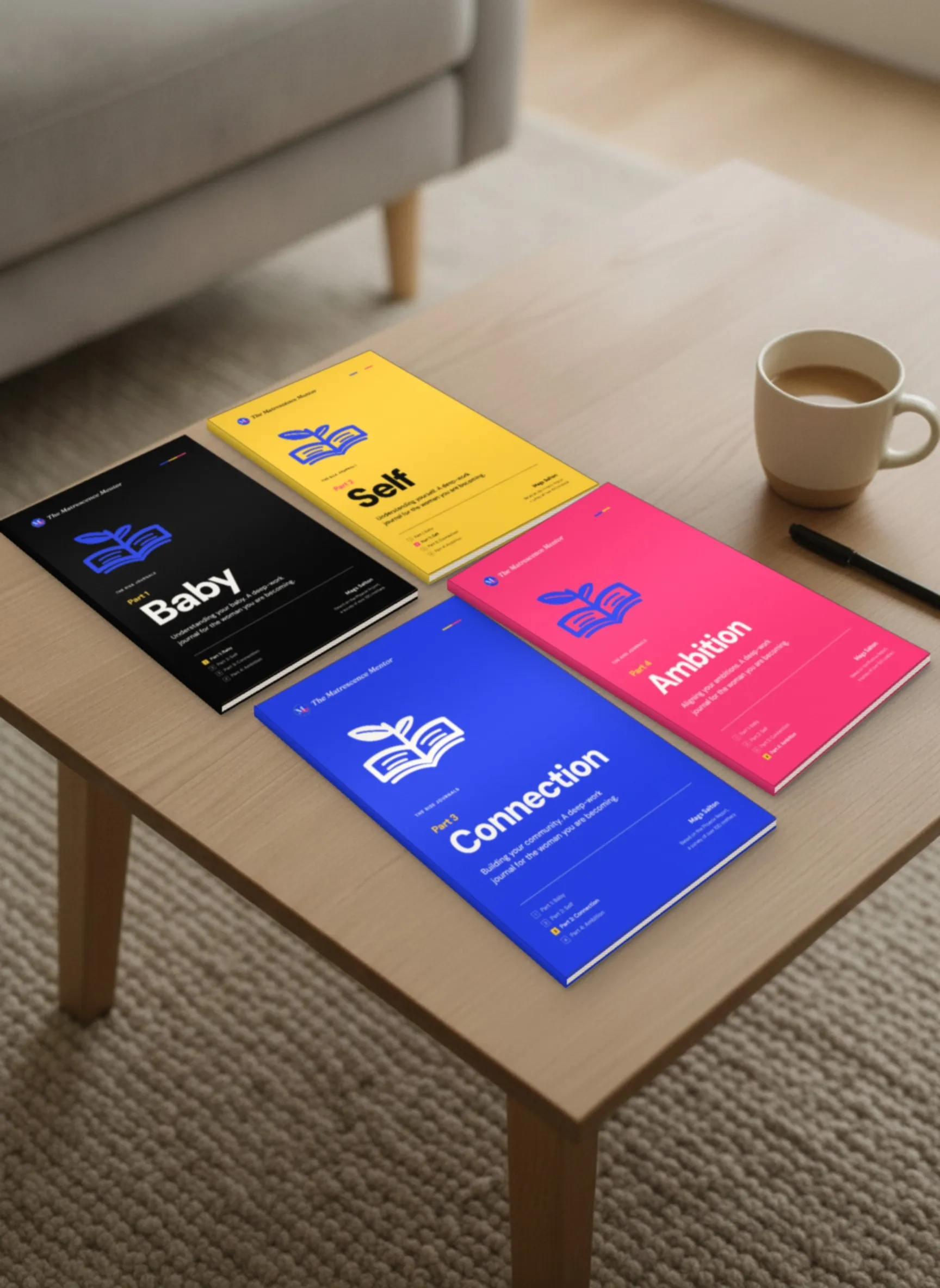
The RISE Journals: Gift Set
Everything at the baby shower is for the baby. This one is for her.
Four printable journals for her first year. Pick the morning they reach her, the shower or her due date, and print a card for the gift table tonight.
Why this gift
Look at the gift table.
She has enough onesies for six babies. The stroller is covered. Everything left is for the nursery. The spa set goes in a drawer, and she will get plenty of advice.
If you have had a baby, you remember that year. Everyone asked about the baby. Few asked about you.
This is the one gift that asks how she is.
How it works.
Three steps, and nothing reaches her before the day you choose.
Choose the journals
All four journals, $45. Single parts from $17.
Pick the day
Straight away, or the morning of any day up to six months ahead: the shower, her due date, her first week home.
Print the card
Your receipt brings a printable card for an envelope or the gift table. Her link goes only to her.
Shower this weekend? There is still time. Choose today, print the card tonight, and her journals reach her on the morning you pick.
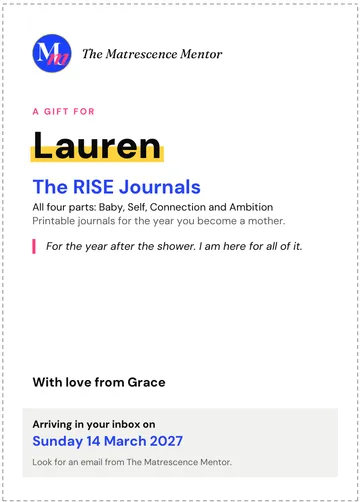
The card
Something to put on the gift table.
A 5 x 7 inch card with her name, your message and the day her journals arrive. It never shows the link or the price.
It comes with your receipt. Print it at home, cut along the dashed line and slip it into an envelope.
The four journals
One for each stage of her first year.
Journal 1
Baby
The first three months
Understanding her baby
Journal 2
Self
From three to six months
Understanding herself
Journal 3
Connection
From six to nine months
Building her community
Journal 4
Ambition
From nine to twelve months
Aligning her ambitions
Journal 1: Baby
The first three months
Understanding her baby
Her baby has just moved worlds. This journal helps her see the first months from her baby’s side, so the cues begin to make sense and she can trust what she notices.
Inside her journal
- The fourth trimester: the change her baby has just made
- What her baby arrives with, and how sleep, feeding, movement and the senses develop
- What to look out for, and a Take action page to track it
- How her confidence grows from what she notices
- Observation pages and two cheat sheets to keep close
Journal 2: Self
From three to six months
Understanding herself
Becoming a mother reorganises her body, her brain, her relationships and her sense of who she is, all at the same time. This journal explains what her body and brain are doing, so the strange weeks make sense.
Inside her journal
- What her body and brain are doing, explained
- The voice she uses with herself, and a kinder one
- What she misses, what she keeps and what she is discovering
- The core values she wants to carry forward
Journal 3: Connection
From six to nine months
Building her community
Matrescence reshapes every relationship around her. Part 3 looks at who holds her now, and helps her build the village every new mother needs.
Inside her journal
- The science of why mothers need support
- Her village map, and who holds which part of the load
- Her needs and boundaries, and how to say them out loud
- The partner conversation and a fair share of the mental load
Journal 4: Ambition
From nine to twelve months
Aligning her ambitions
Motherhood does not end her ambitions. It changes them. Part 4 is for when her leave is ending: what she wants from work now, and her next thirty days, planned on paper.
Inside her journal
- Redefining success for this season
- Why the motherhood penalty is not her fault
- Her perfect ordinary day, and what stands in the way
- Her next thirty days and her return to work
Take a look inside
The change of becoming a mother has a name: matrescence. Each journal names what is changing, shows the research, then asks her one question. Not a blank page, and not advice. Here are two real pages from Part 2: Self.
Part 2: Self
Recognise
Understanding yourself
The identity shift nobody warned you about
62%9
of mothers felt foreign in their own body postpartum
Your brain is undergoing a restructuring that researchers compare to the fine-tuning of puberty.10,20 In the days after birth, your hormone levels change abruptly and dramatically.11
Your identity, values, and priorities fundamentally reorganise. Neuroscientists call this maternal brain plasticity.12
The reframe
You are not recovering the woman you were. You are integrating the woman you are becoming.
These are completely different processes.
Part 2: Self
Investigate
Self-compassion
How do I speak to myself?
The shift: from self-judgement to self-understanding.
You now know what your body and brain are doing. The next layer is the inner voice that turns ordinary struggle into evidence that you are failing. Listen to it closely, because it is often not even your own.
What am I expecting of myself right now that I would never expect of someone I love?
When I struggle, what do I say to myself? Whose voice does that sound like?
Sources on these pages
- 9Salton, M. The Phoenix Report: a survey of 110 professional mothers in 11 countries. The Matrescence Mentor. matrescencementor.com/phoenix-report
- 10Hoekzema, E., Barba-Müller, E., Pozzobon, C., et al. (2017). Pregnancy leads to long-lasting changes in human brain structure. Nature Neuroscience, 20(2), 287–296.
- 11Hendrick, V., Altshuler, L. L., & Suri, R. (1998). Hormonal changes in the postpartum and implications for postpartum depression. Psychosomatics, 39(2), 93–101.
- 12Kim, P., Leckman, J. F., Mayes, L. C., Feldman, R., Wang, X., & Swain, J. E. (2010). The plasticity of human maternal brain: Longitudinal changes in brain anatomy during the early postpartum period. Behavioral Neuroscience, 124(5), 695–700.
- 20Pritschet, L., Taylor, C. M., Cossio, D., et al. (2024). Neuroanatomical changes observed over the course of a human pregnancy. Nature Neuroscience, 27, 2253–2260.
Why would an exhausted mother sit down with a pen?
Putting a feeling into words calms the brain’s alarm centre. Writing it down helps: a 2015 trial with new mothers found it eased postpartum distress. Part 2: Self lists 32 sources. Here are four.
Psychological Science
Writing about emotional experiences is linked to better physical and mental health.
Psychological Bulletin
Across 146 studies, writing about feelings brought a small but reliable benefit.
Psychological Science
Putting feelings into words reduces activity in the amygdala.
Psychological Reports
Expressive writing eased postpartum depression and stress symptoms.
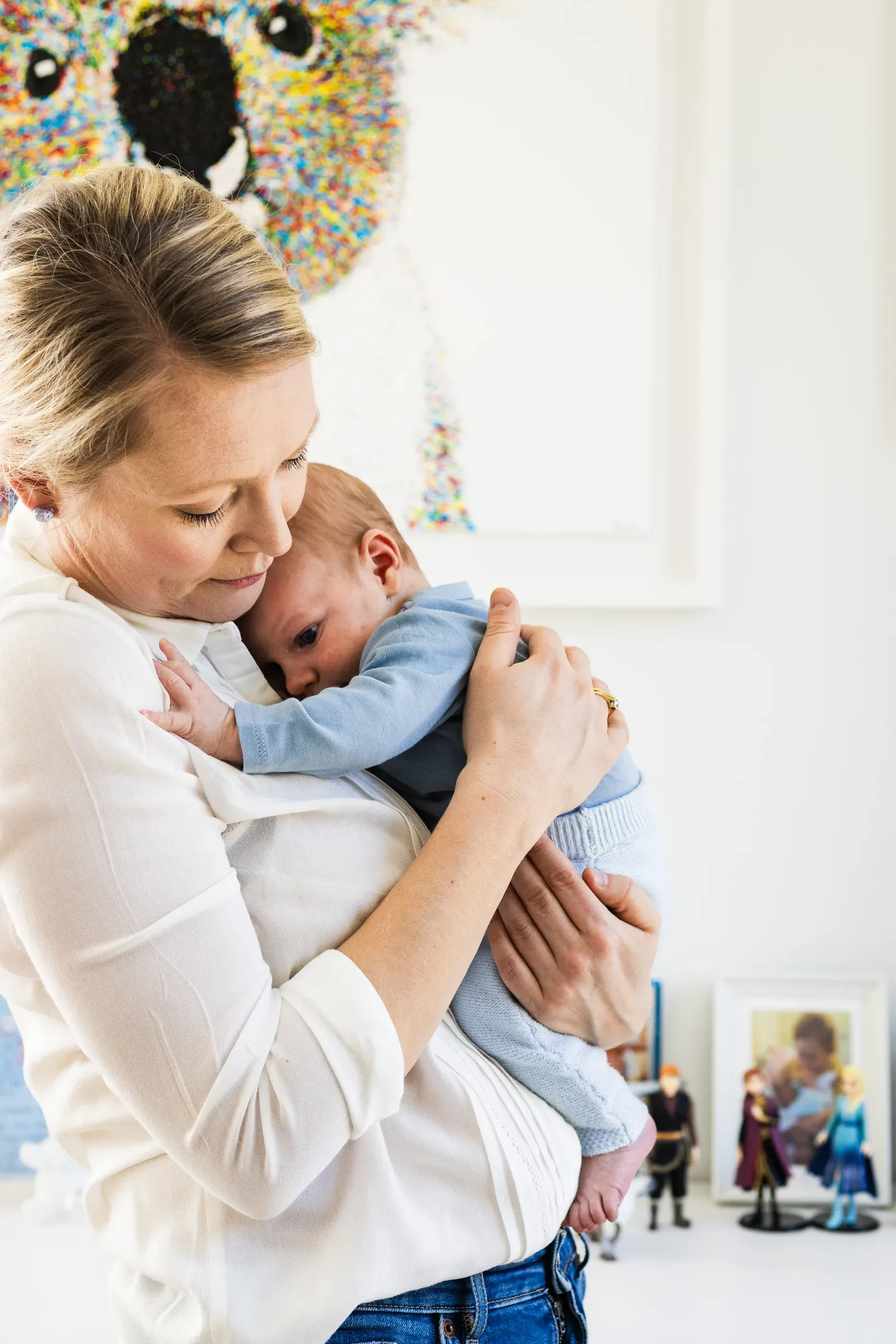
Who made this
Founder of The Matrescence Mentor.
“I gave birth to my first baby in 2020, on the Friday, just before COVID lockdown. Two days later I was sitting at my kitchen table, holding my tiny, screaming baby, feeling completely isolated and lost. I had spent years with children, so why couldn’t I understand my own? I wrote these journals for the woman I was that year. I wish someone had given them to me.”
“I made these for the year nobody prepares you for. Thank you for thinking of her.”
Mags
Credentials
- Mother of three.
- Over ten years helping more than 3,000 mothers and young families.
- MA in Applied Linguistics and Education, University of Warsaw.
- AMI Montessori educator trained in the first three years of life.
- The method
- The RISE framework: Recognise, Investigate, Shift, Embody. Read what is changing, check the research, then write. Ten minutes, one prompt, a pen.
- Who it is for
- A friend, sister or colleague who is expecting, or has just had a baby.
- Investment
- $17 a part, or all four for $45.
What is RISE?
Every page follows the same four steps, so she always knows what to do with her ten minutes.
She names what is changing in her body, her brain, her relationships and her sense of self. Matrescence is a recognised developmental transition, and the evidence is on the page.
“Nothing is wrong with me. I am changing.”
She catches the sentences that run underneath: the shoulds, the rules she inherited, the voice she would never use with a friend. She writes them down and looks at where they came from.
“That rule was never mine.”
She tests each old belief against what she knows now, and chooses a more useful lens. Not forced positivity: a truer sentence she can actually believe.
“I can see this differently, and I choose to.”
She turns the new lens into small daily choices, guided by her own values. Three months later and six months later, the journal asks her to look again and see how far she has travelled.
“This is who I am now, and I am living it.”
Gift questions
Before you give.
Does she need a printer?
Any home printer works, in colour or black and white. The journals are A4; on US Letter, choose “Fit to page”. No printer? A friend or a copy shop can print it. It is not homework: ten minutes, one prompt, a pen, and a single honest sentence counts.
Will she think I’m worried about her?
No. The journals start from a change every mother goes through, not a problem. They are not therapy, and nothing she writes is stored.
What does she get?
An email on the day you choose, with your message and her own link. It opens her private library, where she saves each journal as a PDF to print at home and write in by hand. Her 24 months start that day, and she can add more parts later with the same address.
What if I get her email address wrong?
Nothing is sent before the day you choose. Reply to your receipt and we will put it right.
Who is Mags Salton?
The founder of The Matrescence Mentor and a mother of three. She has spent over ten years helping more than 3,000 mothers and young families. More about Mags.
Can I get a refund?
Yes, as long as you email us before the day it is due to arrive: nothing has been sent, so we refund you in full. Once her link has been sent, they are digital downloads and cannot be refunded. If a download does not work, contact us and we will put it right. Contact us.
Choose her gift.
Payment is taken securely by Stripe. Her link goes to her on the day you choose. Your receipt and the printable card come to you.
Buying for yourself? Choose your journals here.