

Article
Maternal ambivalence: why you feel conflicting emotions after birth
I need to confess something. And it almost feels naughty, because I am, professionally and personally, the main person standing up and preaching the opposite.
Here goes.
I do not always love motherhood.
There. I said it. Out loud, in writing, on the internet, where it will live forever.
And if you felt something shift in your chest when you read that, a small exhale, a flash of recognition, a flicker of oh thank God someone finally said it, then this post is for you.
Because motherhood is hard in ways that nobody quite warns you about. Not just the tired kind of hard. The existential, identity-shaking, where-did-I-go kind of hard.
The list is real
You have to deal with people. Arguably the most difficult people on the planet. Tiny, unapologetic egotists who have absolutely no interest in the fact that you are sleep-deprived, busting to the loo, or mid-sentence. Kids.
And beyond the kids themselves, there is the rest of it.
Motherhood is not valued by the economy. The most significant work many women will ever do is invisible to GDP, unpaid, and publicly unrecognised.
It evokes a FOMO unlike anything else. When you see your childless friends doing spontaneous weekends in Paris and you are still at home, nursing a sick child back to health after a brutal week of killer nursery viruses they dragged in on their tiny contaminated hands.
It is thankless. When did your child last look up from their plate and say “thank you, Mummy, for this exquisite dining experience” after you toiled over a rainbow of lovingly prepared food? Exactly.
It is painful. Physically, in the bringing-a-human-into-the-world sense. And psychologically, in the trying-to-figure-out-who-you-are-now sense.
It is relentless. There is no clocking out. No sick days. No quiet office where you can eat your lunch in peace without someone demanding something of your body.
The list goes on. And it is all real. All of it counts. All of it deserves to be said.
But.
The grief you did not know you were carrying
After my first child, I noticed something. I was going into a spiral of sabotage and negativity more often than not. The hard days would bleed into hard weeks. The thanklessness would stack. The FOMO would compound. And before I knew it, I was living inside a version of motherhood that was mostly grey. Even on the days that were not actually that bad.
I was grieving my old self. Without knowing it.
Research published in Frontiers in Psychiatry (Athan, 2024) formally introduced the concept of grief within matrescence, describing the loss of the pre-mother self as a genuine grief process, involving ambivalence, identity disruption, and the mourning of a former role that was deeply tied to a woman’s sense of who she was.[1]
A 2025 study in Sex Roles (Raneberg and MacCallum) found that maternal ambivalence is nearly universal. And crucially, that what damages mental health is not the ambivalence itself but the inability to acknowledge it without shame.[2] The mothers who are struggling most are not the ones feeling the contradiction. They are the ones who cannot say it out loud.
If the grief has left you feeling you no longer know who you are, How to not lose yourself in motherhood picks up from here.
I was grieving my old self without knowing it. And that grief, unnamed, unacknowledged, socially unacceptable to even whisper, was robbing me of the one thing I actually wanted most. A deep connection with my child. And the chance to show up as my best self for her, and for me.
Here is the part that really got my attention. The more I was showing up as a depleted, dispirited version of myself, the more my baby was moving away from me.
Not because she did not love me. Because babies read everything. And she was reading, this person is not okay.
It was not the motherhood that was making me miserable. It was where I had trained my attention to go.
Why it is so easy to get stuck in the hard
Here is something that will make your brain feel less like it is broken and more like it is doing exactly what it evolved to do. Your brain is wired to notice the negative. It is not a character flaw. It is neurobiological survival equipment.
The human brain has what researchers call a negativity bias. A feature, not a bug, designed to keep us alive by flagging threats, problems, and dangers faster and more persistently than it flags safety, pleasure, and ease. A threat remembered is a life saved. A good meal remembered is just a nice memory.
This is enormously useful when you are, say, avoiding predators on a savannah. It is considerably less useful when applied to the experience of motherhood, where it means that the ten hard moments of a day will stack and echo, while the ten good moments evaporate almost immediately.
The negativity spiral is not weakness. It is a well-practised neural pathway meeting an impossible set of circumstances. The question is not whether it will happen. The question is what you do when you notice it starting.
The ten-second exercise
I want to do something with you. Right now. It takes ten seconds and it is going to demonstrate something about your brain that will make everything else in this post land differently.
Step 1. Look around wherever you are right now. For the next ten seconds, look for everything red. Count how many red objects you can find. Really do it. Do not just read past this step.
Step 2. Now, without looking again, how many blue things did you spot?
Probably not many. Not because the blue things were not there. They were there the whole time. You just were not looking for them.
The same motherhood. The same day. The same child. Completely different experience, depending entirely on where you have pointed the filter.
The neuroscience of where you point your attention
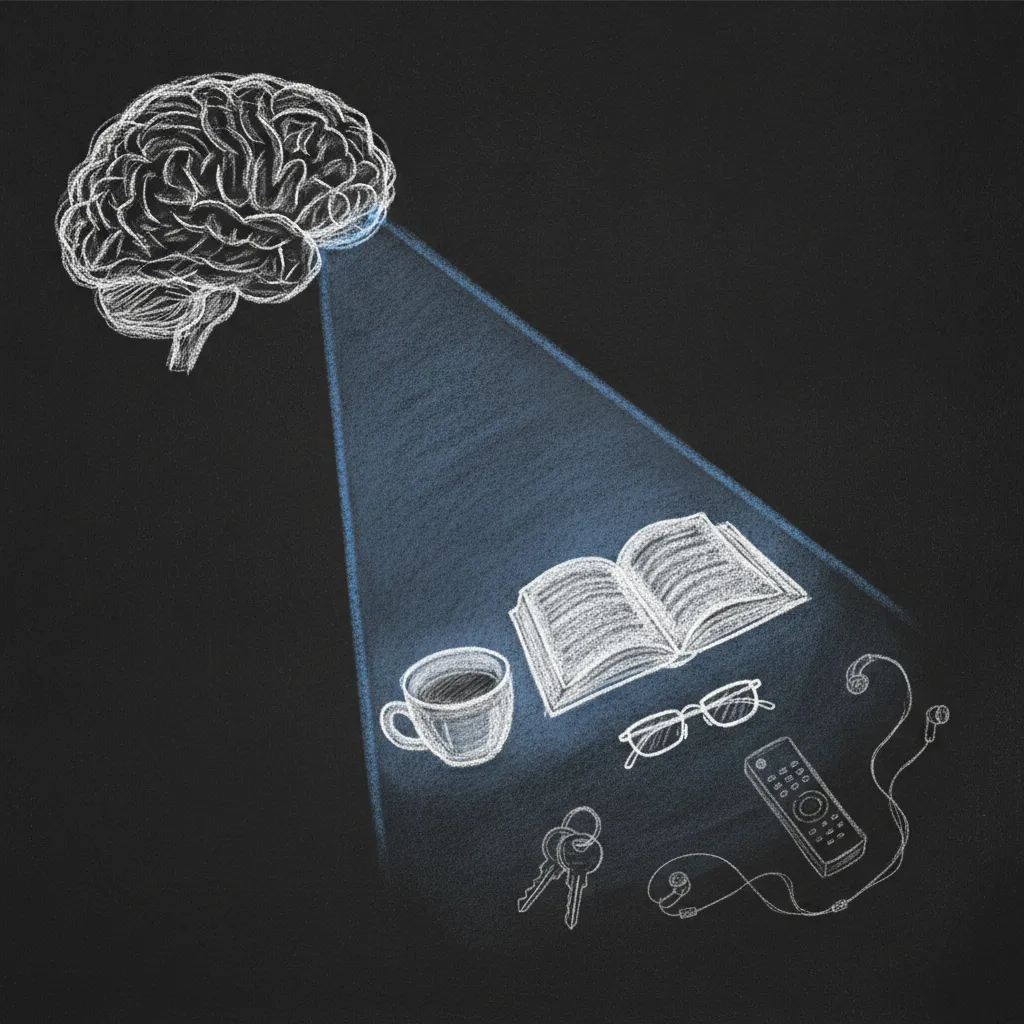
The brain system that governs this is called the salience network. A sophisticated neural circuit centred in the anterior insula and anterior cingulate cortex that determines, moment to moment, which information from your environment is flagged as important, relevant, and worth bringing into your conscious awareness.[3]
The salience network filters the world through the parameters you give it. When you consistently direct your attention toward threat, depletion, and what is not working, the brain becomes increasingly efficient at surfacing more of the same. Not because the positive evidence disappears, but because it has been trained to deprioritise it.[4]
Conversely, intentional attentional priming, deliberately and repeatedly directing focus toward positive evidence, has been shown to shift what the brain surfaces, gradually retraining the filter. The brain’s remarkable neuroplasticity means this is not fixed. The filter can be retrained. Particularly during the heightened neuroplasticity window of early matrescence.
A 2025 pilot study of a matrescence-informed education programme found that teaching mothers to observe, practise non-judgment, and build self-compassion produced measurable increases in self-compassion scores and gains in personal strength even over six weeks.[5] Simply knowing what is happening, and practising where to look, changes the experience.
The more you focus on the red, the more red you will keep seeing. This goes for motherhood too.
Start priming your mind to see the good things. The quiet good things. The small good things. The things that disappear if you do not notice them. The feed that finally worked. The twenty minutes of sleep. The moment she reached for your hand without being asked. The tiny, ridiculous, heart-expanding thing she did that you almost missed because you were in the spiral.
This is a decision, not a disposition
I want to be clear about something, because I said I would be honest and I am going to stay that way. Priming your brain to notice the good does not make the hard things disappear. The sick child still needs nursing. The thankless dinner still needs cooking. The FOMO is real and valid and occasionally brutal. The grief of the old self is real. The ambivalence is real. None of that gets erased.
What changes is not the motherhood. What changes is how much of it you actually experience, versus how much of it you miss because you were stuck in the spiral.
After my first child, when I noticed how deep into the negative I had gone, when I noticed that my baby was moving away from me because I was showing up depleted, I made a decision. Not a dramatic one. A quiet one.
I started looking for the red. Every day, deliberately, I started priming my brain to surface the evidence that contradicted the spiral. Not by pretending the hard things were not there. But by refusing to let the hard things be the only things I was tracking.
Small successes. Good hours. Moments of connection. Things I had done right. Things I had felt, genuinely felt, even in the middle of the exhaustion.
Those small successes turned into good hours. Good hours turned into good days. And good days, accumulated quietly over time, became a different experience of motherhood altogether.
Same life. Different filter.
Motherhood is hard. I said it at the start and I mean it all the way to the end. I do not always love it. Some days I find it almost impossible. Some days the only thing I feel grateful for is that everyone survived.
And also. It is the most extraordinary thing I have ever been part of. Both of those things are true at the same time. That is not contradiction. That is matrescence. The simultaneous experience of expansion and loss, joy and exhaustion, gratitude and grief, all of it at once.
For the wider question of whether it is normal not to enjoy motherhood, and the three-stage arc of Goo, Emerge, and Soar, read Is it normal not to enjoy motherhood?. This post is about where you point your attention while you are in it.
Start priming your mind to see the good. Not because the hard is not real. Because the good is just as real, and it deserves to be seen too.


Frequently asked questions
What is maternal ambivalence?
The simultaneous experience of contradictory feelings during the transition to motherhood. Joy and grief, love and resentment, expansion and loss occurring at the same time, in the same body, on the same day. A 2025 study in Sex Roles found that maternal ambivalence is nearly universal, and that what damages mental health is not the ambivalence itself but the inability to acknowledge it without shame. The problem is not feeling it. The problem is having no language to name it, which leaves women pathologising a normal developmental experience as personal failure.
Why do I feel guilty for not loving every moment of motherhood?
Because you have been handed an impossible standard and asked to perform gratitude for it. The dominant cultural narrative around motherhood prescribes that mothers be devoted, loving, and enjoy caring for their children. When the reality is more complicated, and it always is, the gap between what you feel and what you believe you should feel produces shame. That shame is not information about your quality as a mother. It is information about the gap between cultural expectation and human reality.
Am I grieving my old self after having a baby?
Almost certainly, yes. Even if no one has ever named it that way for you. Research published in Frontiers in Psychiatry formally describes the experience of losing the pre-mother self as a grief process, involving ambivalence, identity disruption, and mourning a former role that was deeply connected to a woman's sense of who she was. The grief is real. It is valid. It is often invisible because the culture has no ritual, no language, and no permission for a woman to mourn the version of herself that no longer quite exists. Unnamed grief tends to show up as depletion, disconnection, and a persistent low-level sense that something is wrong with you.
What is the red and blue exercise for mindset in motherhood?
A simple demonstration of how your brain's salience network works. Look around your environment and actively search for everything red for ten seconds. Then ask yourself how many blue things you spotted. Almost certainly, very few. Not because the blue things were not there, but because your brain had been primed to surface red. Applied to motherhood, the brain filters experience based on what it has been trained to look for. Deliberately and repeatedly directing attention toward small positive evidence begins to retrain the filter.
How do I enjoy motherhood more?
Start by stopping the war against the hard parts. Trying to enjoy motherhood more by suppressing what is genuinely difficult creates an internal dissonance that is exhausting and counterproductive. The ambivalence is real. Let it be real. Then prime your attention deliberately, every day, toward small evidence of the good. Not grand moments. Tiny ones. A feed that worked. A genuine laugh. A moment of eye contact. These moments exist in every day of even the hardest motherhood. The brain needs to be trained to surface them, because left to its default negativity bias, it will not.
Sources and further reading
- 01 (2024). A critical need for the concept of matrescence in perinatal psychiatry. Frontiers in Psychiatry, 15, 1364845.
- 02 (2025). Maternal ambivalence and mothers' mental health. Examining the role of 'good mother' ideals, shame, and self-compassion. Sex Roles, 91, 75.
- 03 (2007). Dissociable intrinsic connectivity networks for salience processing and executive control. Journal of Neuroscience, 27(9), 2349-2356.
- 04 (2015). Salience processing and insular cortical function and dysfunction. Nature Reviews Neuroscience, 16(1), 55-61.
- 05 (2025). Improving maternal well-being. A matrescence education pilot study for new mothers. Maternal Health, Neonatology and Perinatology, 11, 18.
- 06 (2017). The birth of a mother. The New York Times. Link
Keep reading

Is it normal not to enjoy motherhood?
Yes, it is common. 84 per cent of mothers hide their real struggles when asked how they are. What that number says about what you are going through.

How to not lose yourself in motherhood
You have not lost yourself. You are in the biggest identity change of your life, and nobody told you it was coming. Here is what comes next.