
Article
Your identity transformation and the butterfly study
Here is a question I want you to sit with for a moment.
When the caterpillar dissolves, and it does literally dissolve, into a warm liquid soup inside the chrysalis, its body and much of its nervous system breaking down completely, does it have any memory of who it was?
Does any part of the creature that loved leaves and crawled slowly through the world survive what comes next?
Scientists at Georgetown University actually went and found out.
And before I tell you what they found, I want you to notice the question underneath the question. You have been in the soup. You might be in it right now. And somewhere between the woman you were and the mother you are becoming, you have been asking a version of the same thing.
Is she still in there?
What actually happens inside the chrysalis
The popular version of metamorphosis is tidy. Caterpillar goes in, butterfly comes out. Transformation achieved. Moving on.
The actual version is considerably more confronting.
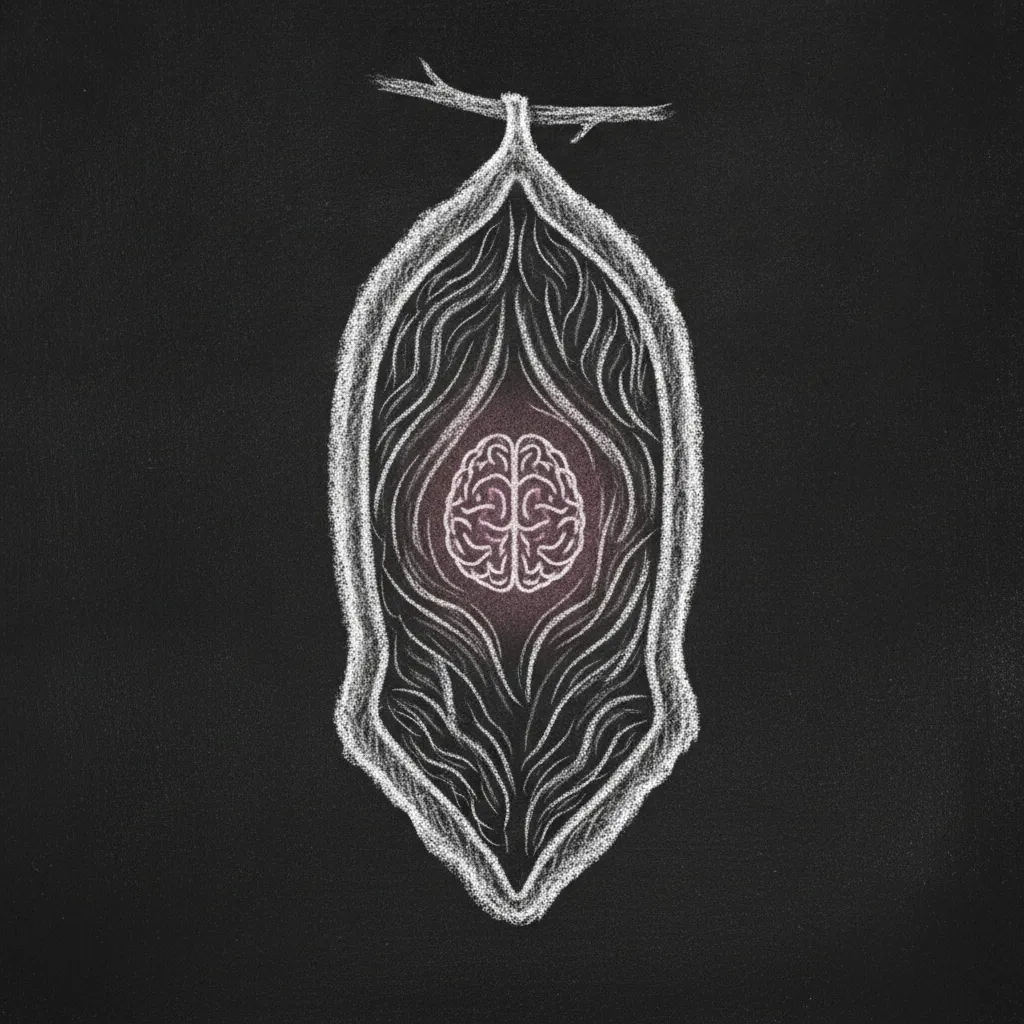
Inside the chrysalis, the caterpillar’s body releases enzymes that essentially digest itself from the inside. Most of its tissues, muscles, organs, even large portions of its nervous system, dissolve into a cellular soup. The creature that entered is no longer structurally intact. It is being completely taken apart and rebuilt.
Which is why the question the Georgetown researchers asked in 2008 was considered, at the time, almost unanswerable.
The Georgetown experiment
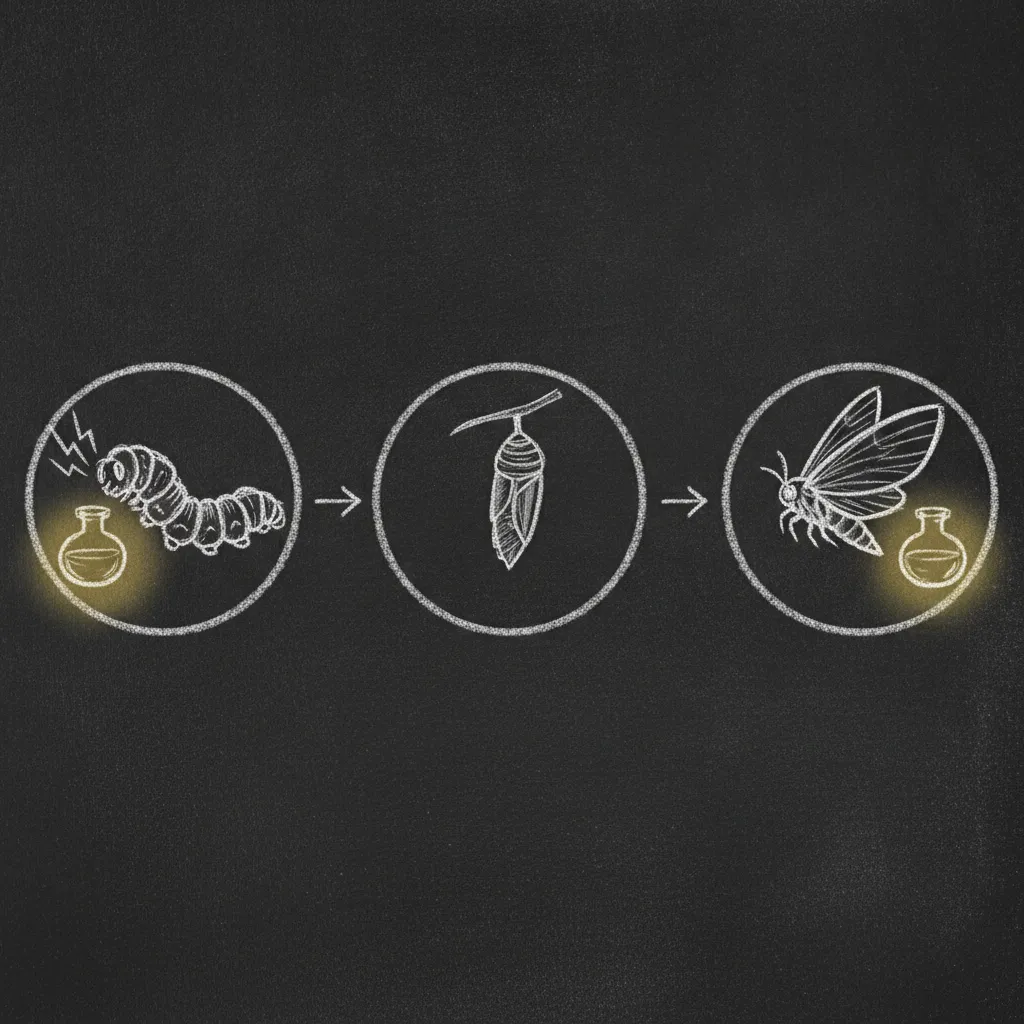
The study was published in PLoS ONE in March 2008 by Blackiston, Silva Casey, and Weiss.[1] Its design was elegantly simple.
The results were extraordinary.
The memory had survived the biological meltdown. It had survived the soup. It had survived complete structural dissolution and reconstruction into an entirely different creature.
The caterpillar, it turns out, remembered.
The mushroom bodies
How does memory survive the dissolution of the brain that holds it?
The researchers found that parts of the mushroom bodies, the areas of the insect brain responsible for learning and memory, remain structurally intact during metamorphosis. They are not erased. They are protected, and then integrated into the architecture of the adult brain.
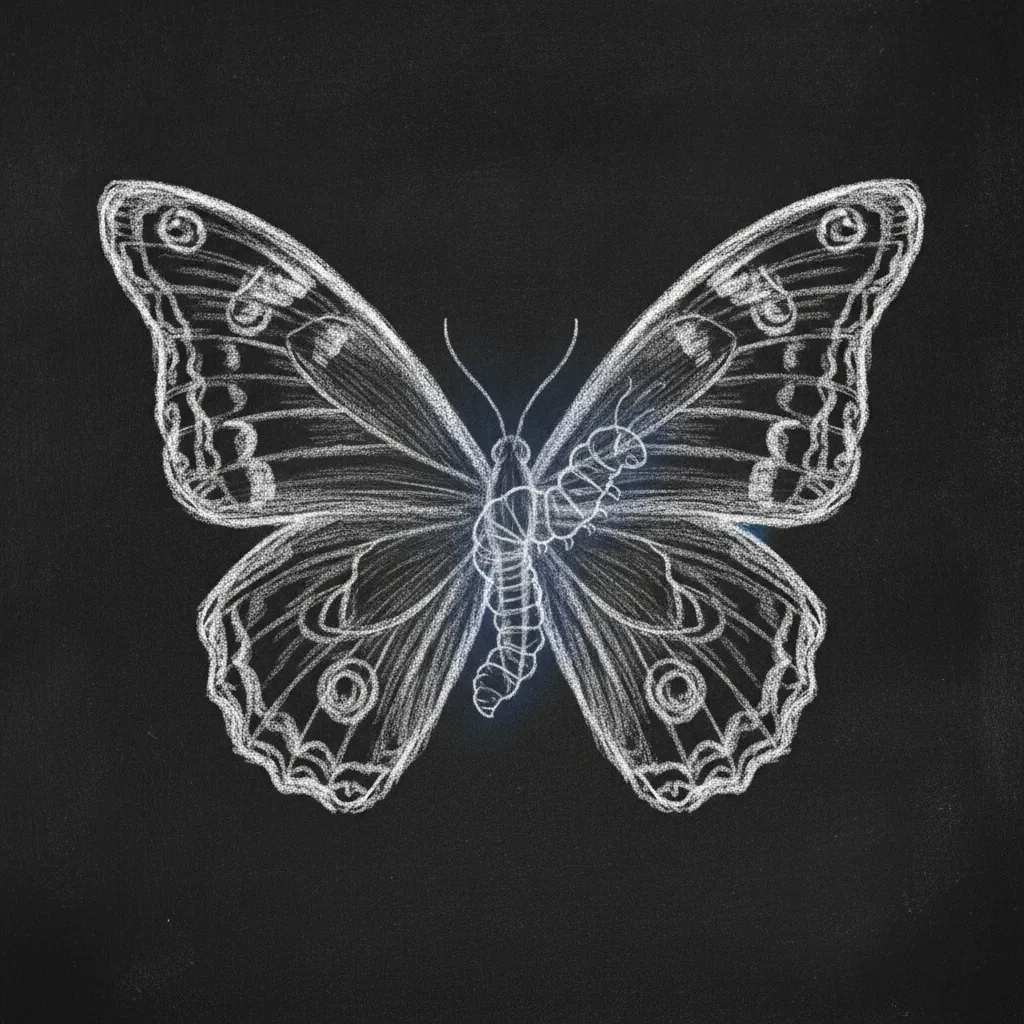
The goo stage is not a deletion. It is a selective survival. The essential lessons, the core wiring, the deepest experience of the creature that went in, these are preserved. They are built into the butterfly.
What this means for you
Matrescence, the scientific term for the process of becoming a mother, is the closest human equivalent to metamorphosis that researchers have found. The neurological literature is increasingly unambiguous about this. The postpartum period involves a restructuring of the brain’s grey matter, a reorganisation of identity, and a transition so significant that it has been compared directly to adolescence in scale and permanence.[2] [3]
You go into the chrysalis a particular kind of person. Your body changes. Your brain changes. Your nervous system, quite literally, rewires. The goo stage is real. You are neither fully the old you nor yet settled in the new you. It is disorienting in ways that are hard to describe to anyone who has not been inside it.
But here is what the moth study says to that.
Matrescence is not a one-way door into someone unrecognisable. It is irreversible. Yes, you cannot go back to the exact person you were before. But it is an expansion, not an erasure. The woman you were is not lost in the transformation. She is the foundation of it.
The things that made you you. Your ambition. Your intelligence. Your sense of humour. Your specific way of caring. The music you love. The things that make you laugh until you cannot breathe. None of that went into the soup and did not come back. It was protected. It was integrated. It is in the butterfly.
Finding her again
Knowing she is still in there is the starting point. What to do about it is the next step, and that deserves its own treatment. For the practical framework, the specific actions, and the question I want you to stop asking yourself, read How to not lose yourself in motherhood.
You did not go into the goo and disappear. You went in, and the most essential parts of you were protected and built into something that has never existed before.
Frequently asked questions
Do butterflies actually remember being caterpillars?
Yes. Researchers at Georgetown University trained tobacco hornworm caterpillars to avoid a specific scent using mild electric shocks. After the caterpillars underwent full metamorphosis, seventy-seven to seventy-eight per cent of the adult moths still avoided the same scent. The memory survived the biological meltdown. The mechanism is that parts of the brain's mushroom bodies, the regions responsible for learning and memory, remain structurally intact through metamorphosis and are integrated into the adult brain.
What is the goo stage of motherhood?
The liminal postpartum period in which a new mother is neither fully the person she was before, nor yet settled into her new self. Researchers describe it as chrysalis-like. Disorienting, in-between, and where the most significant restructuring of identity happens. It is not a sign that something has gone wrong. It is where the transformation is happening.
Will I ever feel like myself again after having a baby?
Not like the exact self you were before, but yes, like yourself. Matrescence is a one-way transition, but it is an expansion, not an erasure. Your personality, your intelligence, your sense of humour, your values. These are the equivalent of the moth's mushroom bodies. They survive the soup and are built into the new architecture.
Is it normal not to recognise myself after becoming a mother?
Completely normal, and one of the most consistently reported experiences of early matrescence. The neurological, hormonal, and identity-level changes are profound enough that researchers compare the period to adolescence in scale and permanence. Not recognising yourself is not the same as having lost yourself. The caterpillar inside the chrysalis, dissolving into soup, could not recognise itself either. It was still entirely there. Just mid-rebuilding.
How do I reconnect with myself after having a baby?
Start by understanding that reconnecting is not about recovering a lost version of yourself. It is about noticing where she has already shown up in the new architecture. A piece of music that stops you mid-task. A conversation where you are suddenly sharp and funny. These are not accidents. They are the parts that survived the soup. For a practical framework and specific actions, read How to not lose yourself in motherhood.
Sources and further reading
- 01 (2008). Retention of memory through metamorphosis. Can a moth remember what it learned as a caterpillar?. PLoS ONE, 3(3), e1736. Link
- 02 (2017). Pregnancy leads to long-lasting changes in human brain structure. Nature Neuroscience, 20(2), 287-296. Link
- 03 (2023). Matrescence. Lifetime impact of motherhood on cognition and the brain. Trends in Cognitive Sciences, 27(3), 302-316. Link
- 04 (2024). A critical need for the concept of matrescence in perinatal psychiatry. Frontiers in Psychiatry, 15.
- 05 (2017). The birth of a mother. The New York Times. Link
Keep reading

The best books on matrescence and becoming a mother
Mags Salton's own reading list for becoming a mother: Lucy Jones's Matrescence and eight more books, with who each suits and when to read it.
How matrescence is like adolescence, and how it isn't
Matrescence is often compared to adolescence. What brain scans of mothers and teens show, where the comparison breaks, and does pregnancy shrink your brain?