
Article
How matrescence is like adolescence, and how it isn't
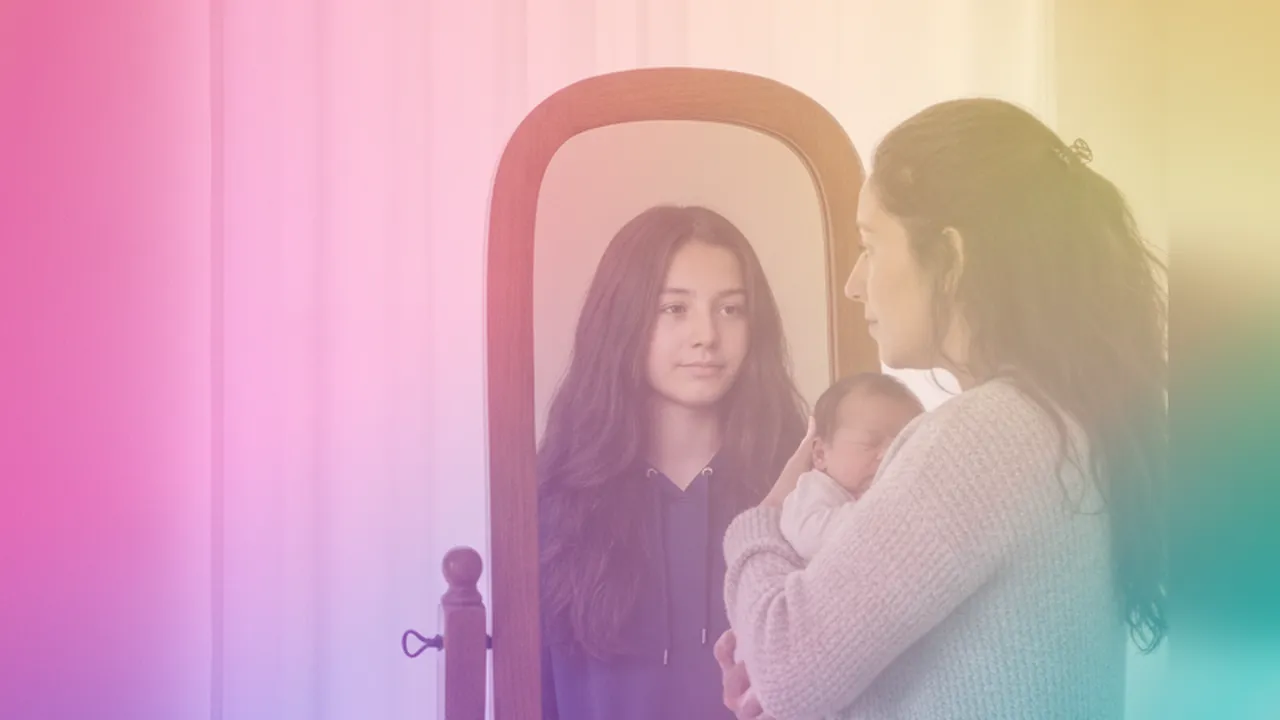
Think back to fifteen. Your body was changing faster than you could keep up with. Your moods arrived without warning. Some mornings you looked in the mirror and did not quite recognise the person looking back.
And the adults around you shrugged. It is a phase, they said. You will grow into it.
Now look at your life since the baby. A body you are still getting to know. Feelings that arrive out of nowhere. A version of you that you are still meeting. It is the same kind of upheaval. This time, almost nobody tells you it is a phase you will grow into.
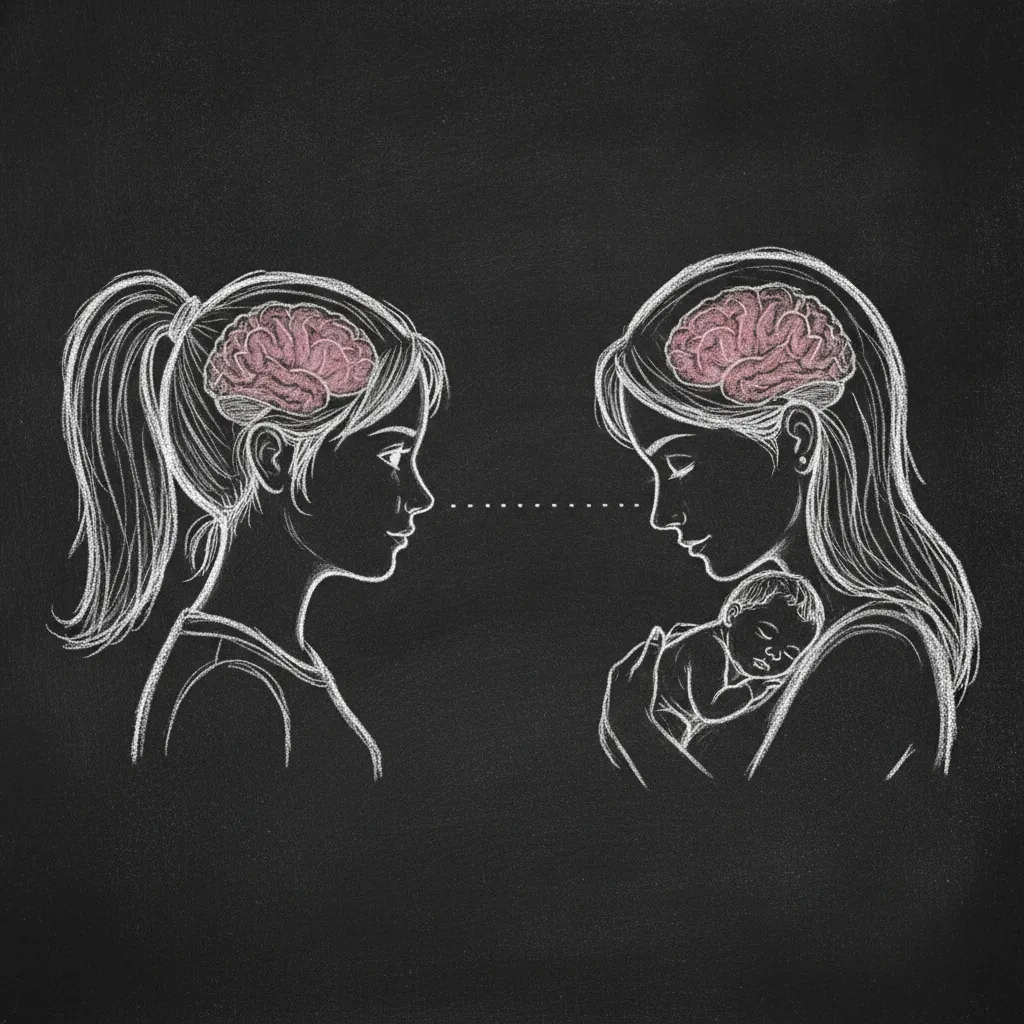
That is why the line “matrescence is like adolescence” lands so hard when you first hear it. But is it true, or just a comforting slogan? One study set the brain scans of first-time mothers and teenage girls side by side. The pattern of change matched.[1]
So the comparison is more than a nice line. It is not a perfect one either. Here is where it holds, where it breaks, and what you can do with it this week.
Where the comparison comes from
The anthropologist Dana Raphael introduced the word matrescence in her 1973 book The Tender Gift, to put the focus on the mother herself.[2] You can hear adolescence in it. The story of how that word was born and then forgotten is worth reading on its own. Today the comparison is most often quoted through the clinical psychologist Dr Aurélie Athan, who revived the term. She describes matrescence as “akin to adolescence but for mothers”.[3]
The point of the comparison was never to make you sound like a moody teenager. It was to give a normal passage a name. Adolescence is a word everyone understands. Nobody thinks a teenager is broken for changing. The comparison asks you to extend the same understanding to yourself.
What happened when scientists compared the two brains
Plenty of people say matrescence is like adolescence. Testing it is another matter. In 2019, a team of researchers in Spain and the Netherlands, led by Susana Carmona, did exactly that in Human Brain Mapping.[1]
They took brain scans from 25 first-time mothers, once before they conceived and again soon after the birth. They took scans from 25 teenage girls, once in mid-puberty and again about two years later. Then they compared how each group’s brain had changed. The changes in the mothers did not differ from the changes in the teenagers on any of the measures they took. Same shape, same direction. The authors suggested that both reflect similar processes primed by hormones.
That study built on earlier work from the same research group. First-time mothers lost grey matter volume during pregnancy, mostly in regions we use to understand other people.[4] Those changes were linked to how attached the mothers felt to their babies. They were still visible two years after the birth.
Here is what I want you to notice. One study is one study, and it was small. But it is the strongest evidence that “matrescence is like adolescence” is more than a metaphor. If you carried your baby, your brain has been through the kind of change your teenage brain once went through. You came through that one.
Does pregnancy shrink your brain?
Grey matter volume falls by about 4.9% during a first pregnancy, then comes partly back, by about 3.4%, by six months after birth.[5] Researchers link this to the brain specialising, much as a teenage brain loses grey matter as it matures.[1]
So yes, something gets smaller. But the word “shrink” tells you far less than the full picture does.
Grey matter is the brain’s outer layer of nerve cells, where much of its processing happens. White matter is the wiring underneath, which carries signals between regions. The largest study so far followed 127 first-time mothers in Barcelona, with scans from before conception to six months after birth.[5] Grey matter dipped through pregnancy and partly returned in the months after birth, without fully returning to where it started. The dip tracked the mother’s oestrogen levels. Mothers whose grey matter came back more strongly also tended to report a stronger bond with their baby at six months. And the pattern appeared only in the mothers who carried the baby.
Grey matter is also only part of the picture. One woman was scanned 26 times, from before conception to two years after the birth. Her grey matter fell while measures of her white matter, the wiring, went up, with “few regions untouched”.[6] That is a single person, so it shows what is possible rather than what is typical. And in a small follow-up of some of the mothers from the two-year study, most of the changes were still visible six years on.[7]
Now hold that next to adolescence. Teenage brains lose grey matter steadily through the second decade of life, while white matter grows into the late teens.[8] Nobody calls that shrinking. We call it growing up. The researchers who compared mothers with teenagers suspect the pregnancy changes are the same kind of fine-tuning.[1]
If you want to know how this feels day to day, that has its own post. For now, keep this. Less grey matter is not less of you.
Five ways matrescence mirrors adolescence
The brain is the headline, but the parallel runs wider. Here are five places to look, and how closely each one matches.
| Dimension | Adolescence | Matrescence | How close |
|---|---|---|---|
| Hormones | A surge of sex hormones at puberty | A steep rise in pregnancy, then a sharp fall after birth | Close in kind. The size of each rise is not compared here. |
| Brain | Grey matter falls, white matter grows | Grey matter falls in pregnancy, partly returns after birth | The closest match. One study found the same pattern. |
| Body | Rapid growth and a new shape | Pregnancy and birth reshape the body within months | Close in speed. Different in what changes. |
| Identity | Working out who you are | Working out who you are now that someone calls you mum | Close. Both reach every part of life. |
| Social role and risk | A new role, a raised risk of mental health problems | A new role, a raised risk of mental health problems | Both carry raised risk. The role points the other way. |
Hormones. In both transitions, a rise in steroid hormones appears to help remodel the brain.[6] The team behind the 26-scan study describes hormone production rising 100- to 1,000-fold in pregnancy, including oestrogen and progesterone.[6] Then, in the hours after birth, oestrogen and progesterone drop sharply.[9] If you want the fuller cast, read what happens to your hormones after birth.
Identity. Athan points out that adolescence brings the same all-encompassing kind of change. That is why ideas from adolescence can guide how we think about mothers.[3] A teenager is not asked to stay who she was at eleven. You are not being asked to stay who you were before the baby. Read more on how identity reshapes in early motherhood.
Risk. The researchers who compared the two brains noted that both transitions come with a raised risk of mental health problems.[1] That is not a reason to fear this passage. It is a reason to take your own wellbeing seriously while you are in it. If this feels heavier than ordinary tiredness or low mood, speak to your doctor or midwife.
Where the comparison breaks
Even Athan, who champions the comparison, calls it “imperfect”.[3] She is right. The match falls apart in four places, and they matter as much as the places where it holds.
It has no end date. The World Health Organization defines adolescence as ages 10 to 19.[10] Some researchers argue it runs to 24.[11] Either way, there is a boundary. Matrescence has none. Athan describes its length as individual, with no clear endpoint, and says it “recurs with each child”.[3] So if you are waiting for a finish line, you may be waiting for something that does not exist.
The direction of dependence flips. Adolescence moves you from depending on others towards independence. Motherhood moves you to “supporting one’s own dependents”, as one review puts it.[12] A teenager is growing towards her own life. You are growing while someone else’s life depends on you. That is a different weight to carry through a transition.
You arrive as an adult. A teenager is building an identity from scratch. You arrive with one already formed: a career, relationships, opinions, a way of doing things that worked. You are not becoming someone for the first time. You are renegotiating someone who already existed.
Not every mother carries her baby. In the largest study, the grey matter dip appeared only in the mothers who carried the baby, not in partners who became mothers without the pregnancy.[5] But matrescence is wider than pregnancy. Athan’s definition covers surrogacy, adoption and early parenting.[3] If you became a mother through adoption, or your partner carried your child, your matrescence is real. The brain data simply describes one route into it.
Then there is the missing script. Adolescence is widely recognised as a significant stage of development.[3] The people around a teenager expect some turbulence. Mothers are rarely given the same room. Athan writes that “a bias towards pathologizing maternal experiences persists in research and practice”.[3] In other words, when a mother struggles, research and care are quicker to look for a disorder than to see a passage in progress. It helps to see how Western culture handles the months after birth, because that is the script you were handed.
One more honest limit. The brain studies so far are few, mostly small, and mostly from Europe and the US. They describe what researchers have seen in those mothers, not in every mother everywhere.
Why the comparison is still worth keeping
Imperfect does not mean useless. The comparison does one job brilliantly. It moves this whole experience out of the category of things going wrong and into the category of development.
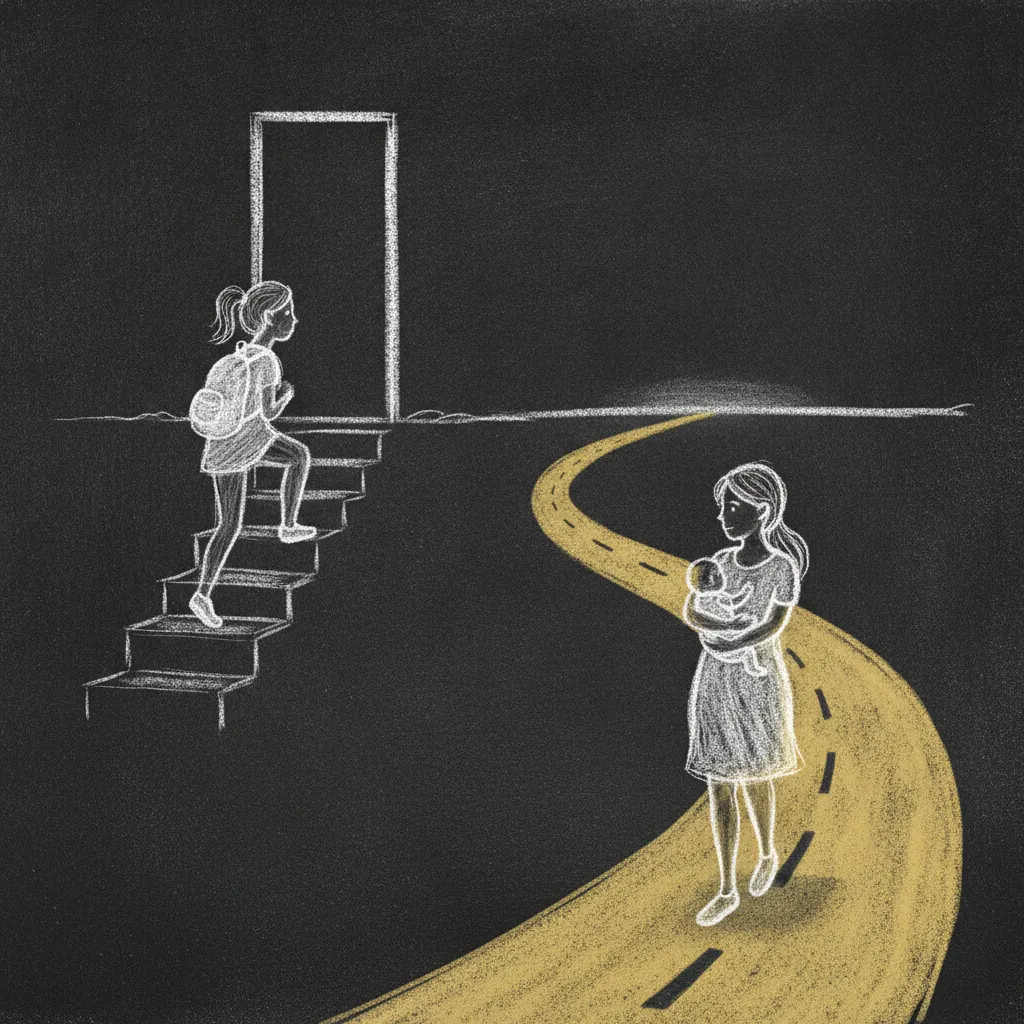
That matters. If you see the past year as a test, every hard day is a mark against you. If you see it as a coming of age, hard days are simply part of the passage. Matrescence is not a disorder or a breakdown. It is a normal developmental passage, as significant as the one you went through at fifteen.
So here is the question to take into your week. Which part of your life is still mid-change? Your work, your friendships, your body, your sense of who you are. Pick one. Then ask what you would allow a teenager in the same place. More time, probably. More patience. Fewer verdicts.
Give yourself that.
You are not failing the test. You are growing up again.
If you would like support through this passage, the RISE Experience is Mags’s twelve-week mentoring programme for women in early motherhood. Or start with a single one-to-one coaching hour.
Frequently asked questions
Is matrescence really like adolescence?
In important ways, yes. One study found that first-time mothers' brains changed in the same pattern as teenage girls' brains. Both transitions also bring hormone shifts, a new identity and a new social role. But the comparison breaks in places. Matrescence has no end date, someone depends on you, and you arrive at it as an adult.
Does pregnancy shrink your brain?
Grey matter volume falls by about 4.9% during a first pregnancy, then comes partly back, by about 3.4%, by six months after birth. Researchers link this to the brain specialising, much as teenage brains lose grey matter as they mature. Less grey matter is not less of you.
Do adoptive mothers go through matrescence?
Yes. Matrescence covers adoption, surrogacy and early parenting, not only pregnancy. In the largest study, the grey matter dip appeared only in mothers who carried their babies. So the brain research describes one route into matrescence. It does not define who counts.
Where does the comparison with adolescence come from?
Anthropologist Dana Raphael introduced the word matrescence in her 1973 book *The Tender Gift*, and the word itself echoes adolescence. Clinical psychologist Dr Aurélie Athan, who revived the term, describes matrescence as "akin to adolescence but for mothers". She also calls the comparison imperfect.
Is the teenage brain change the same as the pregnancy brain change?
In one study, the pattern looked the same. Researchers compared scans from first-time mothers and teenage girls and found no difference in how their brains changed on any of the measures taken. They think both reflect similar processes primed by hormones. It was a small study, so treat it as a strong lead rather than the final word.
Sources and further reading
- 01 (2019). Pregnancy and adolescence entail similar neuroanatomical adaptations: a comparative analysis of cerebral morphometric changes. Human Brain Mapping, 40(7), 2143-2152. Brain scans of 25 first-time mothers (before conception and early after birth) and 25 adolescent girls (mid-puberty and about two years later). Small samples from Western European cohorts; the authors note they cannot separate changes in pregnancy from those in labour or after birth. Link
- 02 (1973). The Tender Gift: Breastfeeding. Prentice-Hall. The book in which Raphael introduced the word matrescence. Link
- 03 (2024). A critical need for the concept of matrescence in perinatal psychiatry. Frontiers in Psychiatry, 15, 1364845. A perspective article by the leading scholar of matrescence, not a data study. Link
- 04 (2017). Pregnancy leads to long-lasting changes in human brain structure. Nature Neuroscience, 20(2), 287-296. First-time mothers scanned before and after pregnancy, compared with first-time fathers and with control groups without children. Spanish and Dutch research team. Link
- 05 (2025). Pregnancy entails a U-shaped trajectory in human brain structure linked to hormones and maternal attachment. Nature Communications, 16, 730. 127 first-time mothers who carried their babies, 20 non-gestational mothers and 32 women without children in Barcelona, scanned five times from before conception to six months after birth. The authors note limited racial and ethnic diversity. Link
- 06 (2024). Neuroanatomical changes observed over the course of a human pregnancy. Nature Neuroscience, 27(11), 2253-2260. One woman scanned 26 times from three weeks before conception to two years after birth. The authors note the findings cannot be generalised from a single person. The white matter finding is a measure of tract integrity, not volume. The hormone figures are the authors' background summary, comparing pregnancy with levels before pregnancy. Link
- 07 (2021). Do pregnancy-induced brain changes reverse? The brain of a mother six years after parturition. Brain Sciences, 11(2), 168. Follow-up of 25 first-time mothers and 22 women without children; only 7 mothers and 5 women without children were scanned at six years, which the authors name as the main limitation. Link
- 08 (2016). Structural brain development between childhood and adulthood: convergence across four longitudinal samples. NeuroImage, 141, 273-281. 391 participants aged 8 to 30, with 852 scans across four longitudinal samples. Link
- 09 (n.d.). Postpartum depression (patient FAQ). ACOG. US guidance, including the sharp fall in oestrogen and progesterone after birth. Link
- 10 (n.d.). Adolescent health. WHO. Defines adolescence as ages 10 to 19. Link
- 11 (2018). The age of adolescence. The Lancet Child & Adolescent Health, 2(3), 223-228. A viewpoint arguing that 10 to 24 fits adolescent growth and today's later life transitions better than 10 to 19. Link
- 12 (2023). Matrescence: lifetime impact of motherhood on cognition and the brain. Trends in Cognitive Sciences, 27(3), 302-316. A review comparing the transition to motherhood with adolescence. Link
Keep reading

The best books on matrescence and becoming a mother
Mags Salton's own reading list for becoming a mother: Lucy Jones's Matrescence and eight more books, with who each suits and when to read it.

Mum guilt: where it comes from and how to let go
Mum guilt (or mom guilt) is not a verdict on you. Where it comes from, how it differs from shame, the research on working mums, and how to let go.